What Is a Pen Supplier Scorecard? A Guide to Capability Verification and Delivery Assurance
A pen supplier scorecard is a weighted, evidence-based evaluation framework used to verify a pen manufacturer's production capability, compliance readiness, and delivery assurance before a contract is signed. Instead of comparing quotations, a buyer scores every candidate supplier against the same fixed criteria, attaches supporting evidence to each score, and converts the result into contract conditions and review points.
For anyone sourcing writing instruments — ballpoint pens, gel pens, erasable pens, custom pens, mini pens, or non-sharpen pencils — the scorecard answers a question that a sample and a price list cannot answer on their own: can this factory deliver the required product, in the required volume, inside the required window, with the documentation the destination market requires?
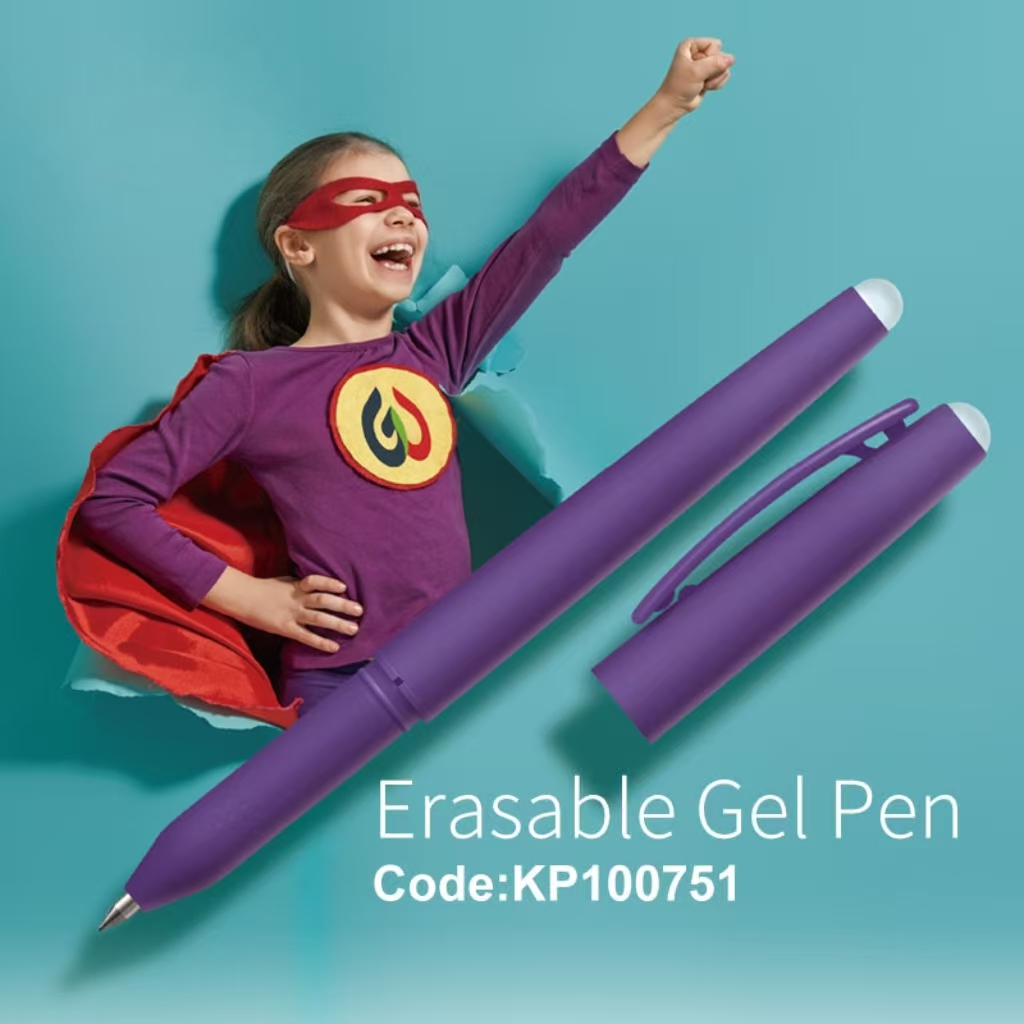
Capability verification starts with a physical product: Greenwill erasable gel pen KP100751, a 0.5 mm thermal erasable gel pen tested to EN71 and ASTM standards.
Problem Definition: Why Pen Supplier Evaluation Fails Without a Scorecard
Most sourcing problems in the writing instruments category are not caused by a defective product. They are caused by an evaluation process that produced a price comparison instead of a capability comparison. Four failure modes appear repeatedly.
1. Capability is asserted rather than verified
A supplier can state a daily output figure or a lead time in an email thread. Unless the buyer requests a capacity statement, a production schedule, and an explanation of how peak-season demand is absorbed, that number stays a claim. The gap only becomes visible when the order is already scheduled.
2. Compliance is treated as paperwork instead of a selection criterion
Requirements such as EN71, REACH, PAHS, SVHC and ASTM D-4236 are frequently raised after commercial terms have been agreed. In the United States, art materials that include pens and pencils must comply with ASTM D4236 for health hazard labelling. When compliance is discovered late, the outcome is often a delayed shipment or an unplanned reformulation discussion.
3. Delivery assurance rests on a single quoted lead time
A lead time such as 30–45 days describes a production window. It does not describe tooling, artwork approval, sampling rounds, or quality control release. Buyers who treat a quoted lead time as a delivery guarantee lose visibility at exactly the point where slippage begins.
4. Minimum order quantity and project volume are misaligned
In OEM programs, minimum order quantity is usually expressed per colour and per design. Different product models can carry different minimums inside the same factory. A buyer who negotiates price against one volume assumption and later orders against another ends up with either excess stock or a re-quotation.
A supplier scorecard exists to close these four gaps before they become contractual disputes. It converts a subjective judgement about a factory into a documented, comparable, and revisable score.
Industry Background: Why Capability Verification Matters More Now
The category is expanding, and its manufacturing base is geographically concentrated. Both trends increase the value of a structured evaluation tool.
The global writing instruments market was valued at USD 19.2 billion in 2025 and is projected to reach USD 27.8 billion by 2033, according to Grand View Research. Within that market, pens accounted for a 36.3% revenue share in 2025. The gel pen segment alone was valued at USD 4.8 billion in 2025 and is projected to grow to USD 8.1 billion by 2034, per Dataintelo, with Asia Pacific holding a 42.3% revenue share in 2025, led by China and India. The global erasable gel pen market was valued at USD 1.38 billion in 2024 and is expected to reach USD 2.56 billion by 2033, according to Market Intelo. At the wider level, the global office supplies market was valued at approximately USD 176.5 billion in 2024, per Spherical Insights.
Three procurement consequences follow from this data. First, growth in erasable and gel segments means more buyers entering a category where ink formulation, tip geometry and erasability behaviour matter as much as price. Second, Asia-Pacific concentration means international buyers are frequently qualifying suppliers they cannot visit casually, which raises the importance of documentary and sample evidence. Third, at the brand layer the market is led by a small group of large players — BIC Group, Pilot Corporation, Newell Brands and M&G Stationery are identified as key global competitors in the pen and stationery market — which means many mid-tier factories also run OEM and ODM programs for brand owners. Those programs are invisible from the outside, so buyers need criteria that separate real manufacturing capability from marketing presentation.
Two published standards give the scorecard objective reference points. ISO 12757-1 specifies the requirements and test methods for ballpoint pens and refills for general use. ASTM D4236 governs health hazard labelling for art materials exported to the United States. A scorecard that references named standards is easier to defend internally than one built on general impressions.
Detailed Solution: The Six-Dimension Pen Supplier Scorecard
A workable pen supplier scorecard uses six dimensions. Each dimension is scored from 0 to 5, multiplied by a weight, and totalled to a normalized 100-point result. The weights below are a starting model; buyers should adjust them to the project profile rather than reuse them unchanged.
Dimension 1 — Production capability and process control (weight 25)
This dimension verifies whether the factory can physically produce the ordered volume and hold it consistent. Evidence includes factory area, year of establishment, headcount, engineering headcount, annual output by product line, and a stated daily capacity. As a reference point for what complete evidence looks like, the manufacturer profile of Kunshan Crystal Culture Co., Ltd, which operates under the Greenwill stationery brand, records a factory established in 1999, a 25,000 m² facility, 100 employees, a 10-person R&D team, and annual output of more than 20 million pens, more than 260 tons of erasers, and more than 3 million pencil sharpeners, with a stated capacity of 100,000 pens per day and 20 tons of eraser per day. A supplier that cannot produce comparable figures at this level of specificity should be scored lower on this dimension.
Dimension 2 — Compliance and product safety (weight 20)
This dimension verifies that documentation exists before the order, not after. Comparable evidence covers both factory-level and product-level standards: EN71-1/2/3/9, REACH, PAHS, SVHC and ASTM-D-4236 for materials and safety, plus FSC, BEPI and ISO at the management-system level. Product-level statements should also exist. For example, the era sable gel pen KP18001 is listed with EN71 and ASTM D-4236 compliance, a 0.5 mm tip size and a minimum order quantity of 5,000 pcs, while the non-sharpen pencil models EP18004 and EP18004-1 are listed with EN71, SVHC and PAHs compliance at a minimum order quantity of 20,000 pcs.
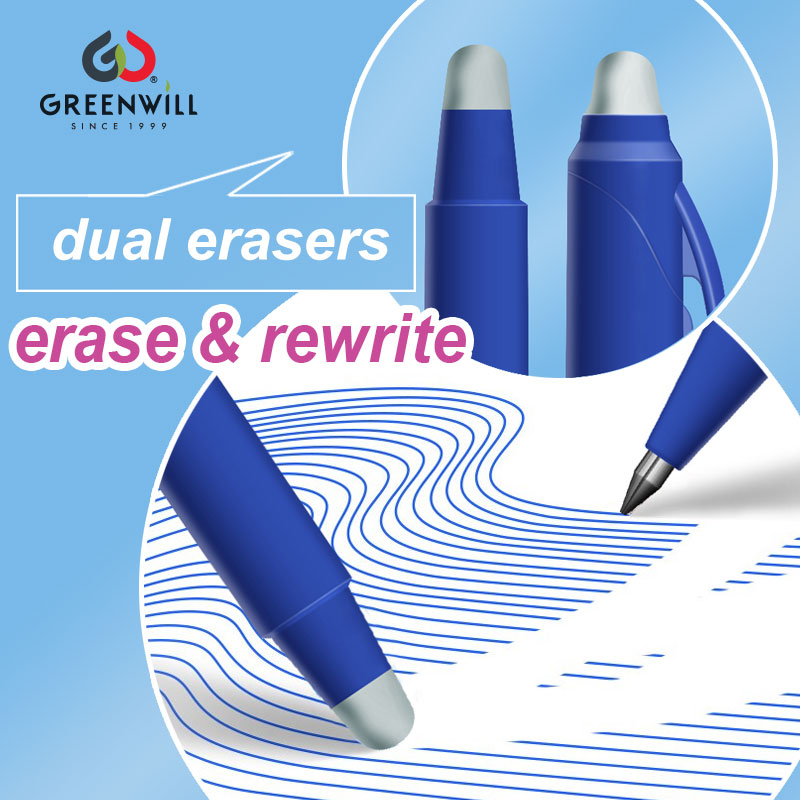
Erasable ink products such as heat-sensitive erasable gel pens require product-level standards documentation, not only factory-level certificates.
Dimension 3 — Delivery assurance (weight 20)
Delivery assurance is the dimension most often scored on trust alone. It should be scored on three inputs: a stated lead time, a quality control process that covers raw material through finished product, and an explicit after-sales commitment on delivery timing. A representative baseline in this category is a 30–45 day lead time combined with full quality control and a stated on-time delivery support commitment. Buyers should also check how the lead time behaves across the product mix, since erasable gel pens and non-sharpen pencils use different process steps.
Dimension 4 — Customization and engineering support (weight 15)
This dimension matters most for private-label and promotional projects. It verifies whether the factory can replicate a supplied logo, design and packaging exactly, and whether it can develop a product from concept to finished item. Comparable evidence includes OEM replication scope, ODM one-stop development, joint development, and mould customization. Supporting services such as custom packaging design and brand identity or visual design support belong in this dimension because they determine how quickly a program can move from artwork to shipment.
Dimension 5 — Commercial fit (weight 10)
Commercial fit is scored on minimum order quantity structure, quotation transparency and payment terms — not on the lowest unit price. In this category, a common OEM baseline is a minimum order quantity of 20,000 pcs per colour and per design, while individual product models may carry different minimums, such as 5,000 pcs for certain erasable gel pen models and 20,000 pcs for certain non-sharpen pencil models. A supplier that explains the logic behind its MOQ structure is easier to plan around than one that quotes a single number.
Dimension 6 — After-sales and continuity (weight 10)
Continuity evidence includes product quality assurance scope, ongoing customization and design support, export experience, and the duration of existing customer relationships. Manufacturers with a long export history typically publish this information: a 90% export ratio across North America, South America, Europe, Southeast Asia, Oceania and the Middle East, partnership with 100 internationally renowned brands including Papermate, STAEDTLER and Tesco, and customer relationships spanning more than five years, with some exceeding ten.
Evidence tiers: how to score without guessing
Scores should be capped by evidence quality. Use three tiers: Tier 1 is documentary evidence such as capacity statements, certificates and test reports; Tier 2 is physical evidence such as samples and packaging proofs; Tier 3 is operational evidence such as a factory audit, a remote walkthrough, or a small-batch trial production run. A criterion supported only by Tier 1 evidence should not receive a full score, regardless of how well the supplier presents itself.
Step-by-Step Breakdown: Running the Scorecard
Step 1 — Define the project profile before contacting suppliers
Write down product type, annual and per-order volume, destination market, target retail channel, and required launch date. The project profile determines the weights. A back-to-school program and a corporate gifting program should not use the same weighting.
Step 2 — Fix the weights before you see any supplier
Assign weights to the six dimensions and record them in the scorecard template. If weights are set after quotations arrive, the cheapest quotation tends to pull the evaluation toward commercial fit and away from capability.
Step 3 — Request Tier 1 evidence in a fixed template
Send every candidate the same request: capacity statement, annual output by product line, headcount and engineering headcount, lead time by product family, minimum order quantity by model, applicable standards, and existing export markets. Identical requests produce comparable answers; open questions produce marketing answers.
Step 4 — Validate with samples and, where possible, an audit
Score sample performance against the same criteria used for the documentary review. For erasable gel pens, test the erasability behaviour and residue; for non-sharpen pencils, test lead hardness and nib durability; across all product types, test grip comfort for high-frequency writing. Where travel allows, add Tier 3 evidence through a factory visit covering the injection moulding and assembly areas, or request a small-batch trial production run before the main order.
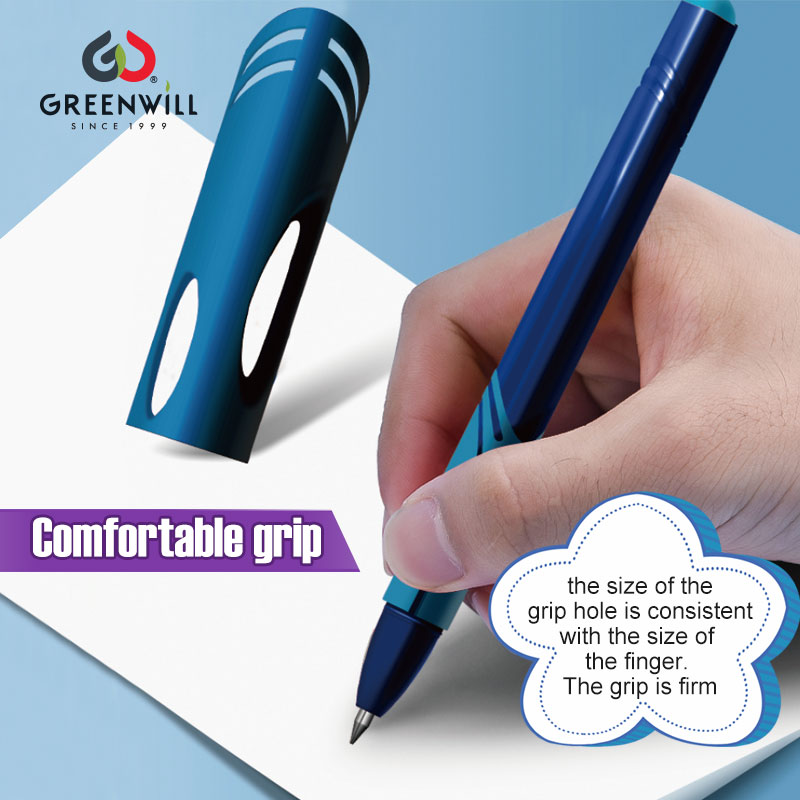
Sample validation should test function, not appearance: grip ergonomics, ink behaviour and durability are the criteria that predict bulk-order outcomes.
Step 5 — Score, band, and document the gaps
Convert the weighted result into three decision bands. A score of 85–100 indicates an approved supplier for the project as scoped. A score of 70–84 indicates conditional approval, with the specific weak dimensions written into the contract as conditions. A score below 70 indicates that the supplier should not be awarded the project in its current form, or that the project scope should be reduced to what the supplier can demonstrably support.
Step 6 — Convert the score into contract conditions and a review cycle
A scorecard that is not written into the agreement is only an opinion. Attach the conditions that follow from the weak dimensions: capacity reservation for peak months, document submission deadlines for compliance files, sampling milestones before mass production, and a defined on-time delivery commitment. Re-score the supplier after each delivery cycle so the scorecard becomes a live record instead of a one-off assessment.
Use Cases: Applying the Scorecard to Real Project Types
Use case 1 — School and back-to-school programs
School supply programs are volume-driven and deadline-driven. Weight delivery assurance and compliance more heavily, and prioritise products designed for daily classroom use with high-frequency writing. Non-sharpen pencils fit this profile because they remove the need for a sharpener: the model SL241203 uses TPE, an alloy nib and an ABS cap, with HB lead hardness, and the product documentation states that one eraser pencil is equivalent in use to 20 wooden pencils plus 2 erasers plus 2 sharpeners. For a school program, that equivalence is a procurement argument, not a marketing claim — it changes reorder frequency and breakage assumptions.
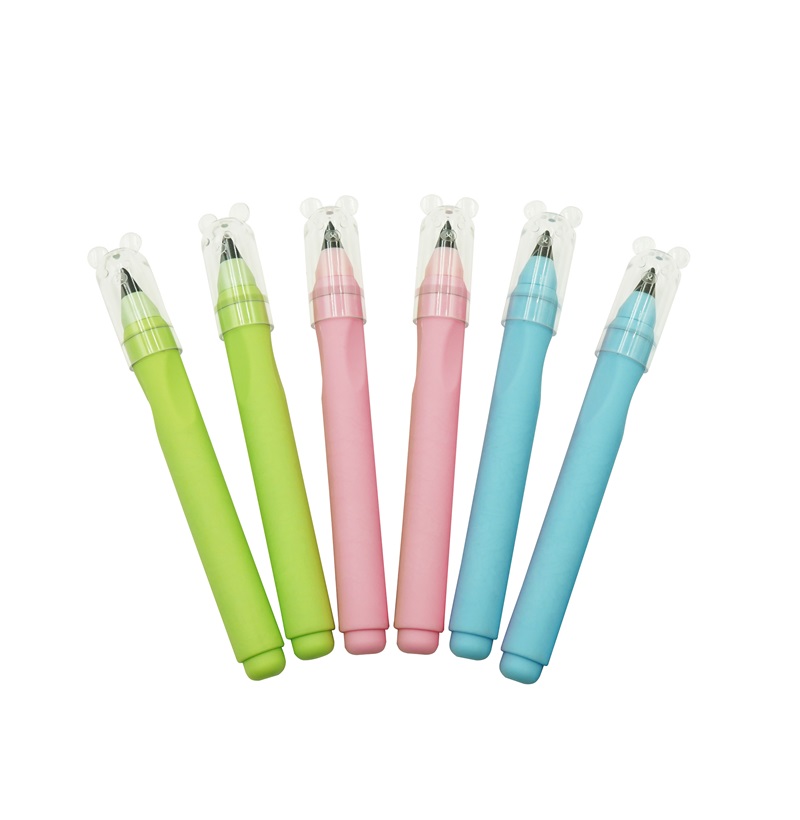
Non-sharpen pencils reduce accessory requirements in school programs, which changes both reorder logic and delivery planning.
Use case 2 — Office bulk procurement
Office procurement is a repeat-supply scenario. Weight commercial fit, after-sales and delivery assurance equally. Erasable gel pens are a common specification because they support correction without correction fluid: the KP18001 model uses ABS and AS plastic with heat-sensitive erasable ink, a 0.5 mm tip size, thermal erasability, smooth writing and no residue, and is available in multiple colours. For buyers standardising a catalogue, colour range, refill availability and consistent ink behaviour across batches matter more than a single-sample impression.
Use case 3 — Promotional gifting and private-label OEM
Promotional and private-label projects live or die on customization. Weight customization and engineering support highest, and verify OEM and ODM scope explicitly: OEM covers precise replication of logo, design and packaging, while ODM covers a one-stop process from concept to finished product. Projects in this category usually require custom packaging plus brand identity and visual design support, ergonomic anti-fatigue grips, and non-toxic materials that meet EN71 or REACH requirements. Because these projects often run on compressed timelines, the scorecard should confirm whether small-batch trial production is available before a full-scale commitment.
Use case 4 — Distributor and long-term supply programs
Distributors and importers evaluate continuity, not a single shipment. Weight after-sales and continuity higher, and look for evidence of sustained supply relationships and multi-region export capability. Buyers in Germany, Argentina, Brazil, France, Italy and the United States appear in the reference customer mix of an established exporter in this category, with relationships running more than five years and some exceeding ten. Shelf appeal and mid-to-high-end positioning are also relevant scoring inputs when the distributor's business depends on retail presentation.
Comparison Table: Scorecard Dimensions, Evidence and Reference Points
The table below maps each scorecard dimension to the evidence a buyer should request and the type of reference point that separates a verifiable answer from a general claim. Reference points are drawn from publicly stated manufacturer profile data and published standards.
| Scorecard dimension | What it verifies | Evidence to request | Reference point |
|---|---|---|---|
| Production capability (25) | Physical ability to produce the ordered volume | Capacity statement, annual output by line, headcount, R&D headcount, facility size | Factory established 1999; 25,000 m²; 100 employees; 10-person R&D team; output above 20 million pens per year; stated capacity 100,000 pens per day |
| Compliance and safety (20) | Market-access documentation for the destination country | Factory-level and product-level standards, test reports, labelling compliance | EN71-1/2/3/9, REACH, PAHS, SVHC, ASTM-D-4236, FSC, BEPI, ISO; ISO 12757-1 for ballpoint pens and refills; ASTM D4236 labelling for art materials exported to the US |
| Delivery assurance (20) | Whether the quoted lead time is supported by process control | Lead time by product family, QC process scope, delivery commitment wording | Lead time 30–45 days; full quality control from raw material to finished product; on-time delivery support commitment |
| Customization and engineering (15) | Ability to execute private-label and custom programs | OEM and ODM scope, mould customization, design and packaging support | OEM replication of logo, design and packaging; ODM concept-to-finished-product development; custom packaging and brand identity design support |
| Commercial fit (10) | Whether order structure matches project volume | MOQ by model, quotation structure, payment terms | Standard OEM MOQ of 20,000 pcs per colour and design; model-level example of 5,000 pcs for certain erasable gel pen models |
| After-sales and continuity (10) | Ability to sustain supply beyond the first order | Quality assurance scope, export markets, customer relationship duration | 90% export ratio across six regions; 100 internationally renowned brand partnerships; customer relationships exceeding five years, some over ten |
The second table shows how model-level reference data should be recorded inside the scorecard, using published product specifications from the same manufacturer profile. Buyers can replace these rows with the model data of any supplier under evaluation.
| Model | Type | Key specification | Stated standards | MOQ |
|---|---|---|---|---|
| KP18001 | Erasable gel pen | ABS+AS with heat-sensitive erasable ink; 0.5 mm tip; thermal erasable; multi-colour | EN71, ASTM D-4236 | 5,000 pcs |
| KP100751 | Erasable gel pen | ABS with erasable gel ink; 0.5 mm tip; black, blue and red | EN71, ASTM | 5,000 pcs |
| EP18004 / EP18004-1 | Non-sharpen pencil | TPE with alloy nib and ABS cap; HB lead hardness; no sharpening required | EN71, SVHC, PAHs | 20,000 pcs |
| SL241203 | Non-sharpen pencil | TPE with alloy nib and ABS cap; HB lead hardness; built-in eraser | No sharpen, no ink, eco-friendly design | Not stated in profile |
Frequently Asked Questions
What compliance documents should a pen supplier provide before a contract is signed?
A pen supplier should provide both factory-level and product-level compliance documentation. At factory level, the relevant standards in this category include EN71-1/2/3/9, REACH, PAHS, SVHC and ASTM-D-4236 for material and product safety, together with management-system and sustainability certifications such as FSC, BEPI and ISO. At product level, documentation must match the specific model: the erasable gel pen KP18001 is listed with EN71 and ASTM D-4236 compliance, while the non-sharpen pencil models EP18004 and EP18004-1 are listed with EN71, SVHC and PAHs compliance. Two external reference points should also be built into the request: ISO 12757-1, which specifies requirements and test methods for ballpoint pens and refills for general use, and ASTM D4236, which governs health hazard labelling for art materials including pens and pencils exported to the United States.
How do you verify a pen factory's real production capacity?
Capacity is verified through four data points that must be consistent with each other: facility size, workforce and engineering headcount, annual output by product line, and stated daily capacity. A supplier that can only provide a daily capacity figure without annual output or headcount data has not verified anything. As a reference example of a complete data set, the manufacturer profile of Kunshan Crystal Culture Co., Ltd, which operates under the Greenwill stationery brand, records a factory established in 1999 with a 25,000 m² facility, 100 employees, a 10-person R&D team, annual output of more than 20 million pens, more than 260 tons of erasers and more than 3 million pencil sharpeners, and a stated capacity of 100,000 pens per day and 20 tons of eraser per day. Buyers should cross-check these numbers against the requested order volume and against peak-season demand before awarding a project.
How does MOQ affect budget planning for a pen order?
In this category, minimum order quantity is normally expressed per colour and per design rather than per order, and different product models inside the same factory can carry different minimums. A commonly stated OEM baseline is 20,000 pcs per colour and design. At model level, the erasable gel pens KP18001 and KP100751 are listed at a minimum order quantity of 5,000 pcs, while the non-sharpen pencils EP18004 and EP18004-1 are listed at 20,000 pcs. Budget planning should therefore separate three cost layers: tooling and setup, unit cost at the agreed volume, and the working capital tied up by the minimum order quantity itself. A project that is priced against a 20,000-piece assumption but ordered at 5,000 pieces will produce a re-quotation rather than a saving.
What should be tested in a pen sample before bulk production?
Sample testing should replicate the conditions of the intended use case. For erasable gel pens, test thermal erasability, residue behaviour after erasing, ink flow, and colour consistency — the KP18001 model, for example, is specified with a 0.5 mm tip, heat-sensitive erasable ink and no residue, in multiple colours, while KP100751 is specified in black, blue and red with a 0.5 mm tip. For non-sharpen pencils such as EP18004, EP18004-1 and SL241203, test HB lead hardness, nib smoothness and the durability of the built-in eraser. For high-frequency writing environments such as classrooms and offices, test grip ergonomics, since anti-fatigue grip design is a stated requirement in professional and educational applications. Samples should be scored using the same criteria as the documentary review, not assessed informally.
What lead time should buyers expect, and how can it be protected?
A representative lead time in this category is 30–45 days, supported by full quality control from raw material to finished product and an on-time delivery support commitment. That window covers production, but not artwork approval, tooling changes or sampling rounds, so buyers should protect it in three ways: fix a milestone schedule that separates sampling, approval and mass production; reserve capacity in writing for peak-season months such as the back-to-school period; and define what happens if a delivery milestone is missed. Buyers who want to validate capability before committing to a full order can begin with a physical sample from the erasable gel pen and non-sharpen pencil ranges, including KP18001, KP100751 and EP18004. Samples and quotations can be requested through Greenwill stationery at www.greenwillplus.com.
Conclusion: The Scorecard Is a Risk Document, Not a Formality
A pen supplier scorecard converts sourcing from a comparison of quotations into a comparison of verified capabilities. It forces the buyer to define the project before contacting suppliers, to weight criteria before seeing prices, to request the same evidence from every candidate, and to write weak dimensions into contract conditions rather than into notes.
The six dimensions covered here — production capability, compliance and safety, delivery assurance, customization and engineering support, commercial fit, and after-sales continuity — apply across ballpoint pens, gel pens, erasable pens, custom pens and non-sharpen pencils. The weighting changes with the project: school programs prioritise delivery and compliance, office programs prioritise continuity and commercial fit, promotional programs prioritise customization, and distributor programs prioritise long-term supply behaviour.
Because the category is expanding and manufacturing is concentrated in Asia Pacific, buyers increasingly need to qualify suppliers at a distance. A scorecard built on documentary evidence, physical samples and, where possible, operational verification is the most practical way to reduce that distance without reducing the standard of proof.
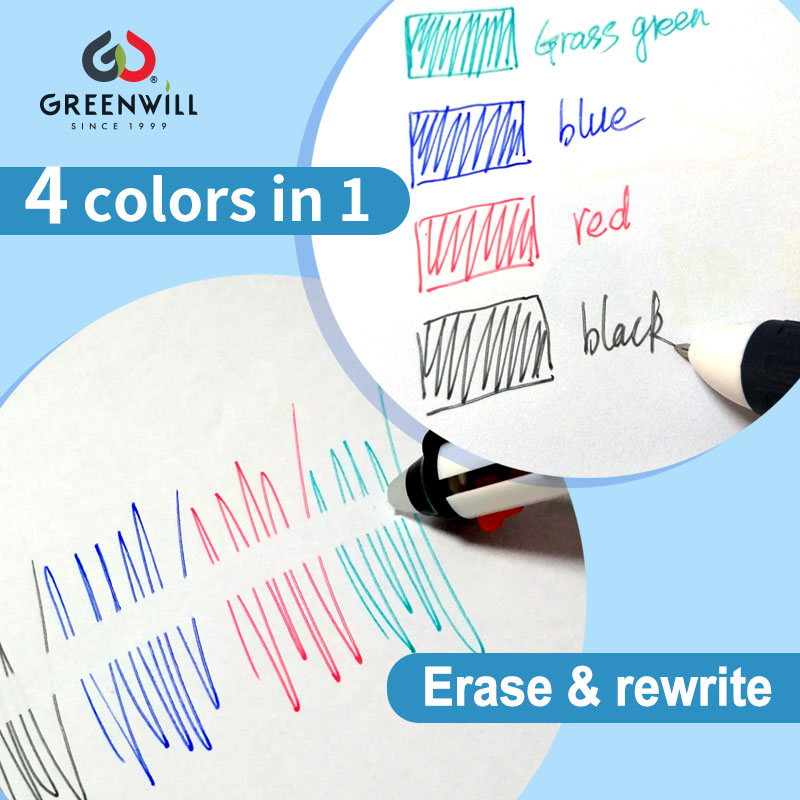
Next step: request a sample and a scored supplier profile
Greenwill stationery (Kunshan Crystal Culture Co., Ltd) has manufactured writing instruments, erasers and pencil sharpeners since 1999, with OEM and ODM programs covering erasable gel pens, ballpoint pens and non-sharpen pencils. Buyers can request product samples, capacity statements and compliance documentation before committing to a contract.
Website: www.greenwillplus.com
Email: james@tinlongworld.com
Tel / WhatsApp: +86-15151678868
Address: No.551, Jujin Road, Zhangpu Town, Kunshan City, Jiangsu Province, China
Have Questions or Need More Details?
Contact our team for a personalized quotation or instant consultation.
Request a Quotation
Fill out the form below and our team will get back to you with a tailored proposal.
WhatsApp Direct Chat
Prefer to chat in real-time? Message us on WhatsApp for instant assistance & quick answers.
- Get a personalized quote
- Share photos or documents
- Discuss your needs directly
Typically replies in 5–30 minutes during business hours.