Eraser and Sharpener Compliance Guide: Certifications and Standards Buyers Should Verify
Erasers, eraser sharpeners and small pencil accessories sit at the low-value, high-volume end of a stationery purchase order. That is precisely why compliance problems in this category are so disruptive: a missing test report, an outdated certificate, or a label that does not match the destination market can hold up an entire mixed container while the product itself is perfectly fine.
This guide is written for buyers who have already reached the evaluation stage — the point where a supplier shortlist exists and the next task is verification rather than discovery. It explains which certificates and standards actually apply to erasers, eraser sharpeners and pencil toppers, how to separate a company management-system certificate from a product test report, and what to request before a purchase order is issued. The examples of documented compliance come from Greenwill (Kunshan Crystal Culture Co., Ltd), a stationery manufacturer based in Kunshan, Jiangsu Province, China, whose factory was established in 1999 and whose product lines include eco-friendly erasers and multifunctional pencil sharpeners.
Problem Definition: Why Eraser and Sharpener Compliance Is Harder Than It Looks
The central difficulty in this category is classification. A block eraser can be an office supply, an art material or a children's product depending on who uses it and how it is sold. A sharpener with an eraser integrated into the body is simultaneously a plastic article, a metal cutting tool and, in many markets, an item that a child handles daily. Each classification pulls the same SKU into a different rule set.
The European Commission's Guidance Document No. 15 is explicit on one of these boundaries: stationery products intended for children under 14, including 'toy' sharpeners and erasers, must comply with the EU Toy Safety Directive 2009/48/EC and the EN 71 standards (Part 1–3). For professional art materials, the relevant framework is toxicological labeling and material safety documentation such as ASTM D-4236. Underneath both sits raw-material regulation — REACH, PAHs and SVHC screening — which applies regardless of how the finished item is classified.
The result is a documentation chain that most first-time importers underestimate. A 2-in-1 eraser sharpener, for example, combines a TPR eraser body, a stainless steel blade and a PP plastic shell. Rules attach to components, not only to the product name, so both the eraser material and the sharpener assembly need to be traceable in the paperwork.

Industry Background: A Large Category With a Growing Documentation Burden
The eraser category is large enough that compliance errors are expensive at scale. Published market estimates for the global eraser market in 2025 range from roughly USD 2.1 billion to USD 2.8 billion, with projections reaching as high as USD 4.3 billion by 2034, according to Dataintelo and MarketIntelo. Other research houses place the 2025 figure far lower — around USD 1.05 billion — depending on whether writing instruments and art supplies are counted inside the same boundary. That divergence is itself a useful signal for buyers: category definitions vary, and so do the regulatory definitions that follow them.
China remains the dominant supply source. China's exports of vulcanized rubber erasers totalled approximately USD 137 million in 2024, with the United States the single largest destination at USD 21.7 million, according to the Observatory of Economic Complexity (OEC). On the sharpener side, the global pencil sharpener market is projected to grow from USD 1.2 billion in 2025 to USD 1.8 billion by 2030, with multifunctional sharpener-eraser combinations outpacing the overall market at a CAGR of over 8%.
That last figure matters for compliance planning. Growth is concentrated in multifunctional designs — devices that integrate an eraser, a pen cap, lighting or other creative features into one body. Every added component adds a material to declare, a part to test, and a potential point of failure in the documentation file. Combined units are also the products most likely to be reclassified by customs or market surveillance authorities, because their function is ambiguous by design.
What a Compliance-Ready Documentation File Actually Contains
A supplier that is genuinely ready for global retail accounts will hold documentation in three distinct layers. Buyers who understand the layers stop accepting a single PDF as proof of everything.
Layer 1 — Management system certificates
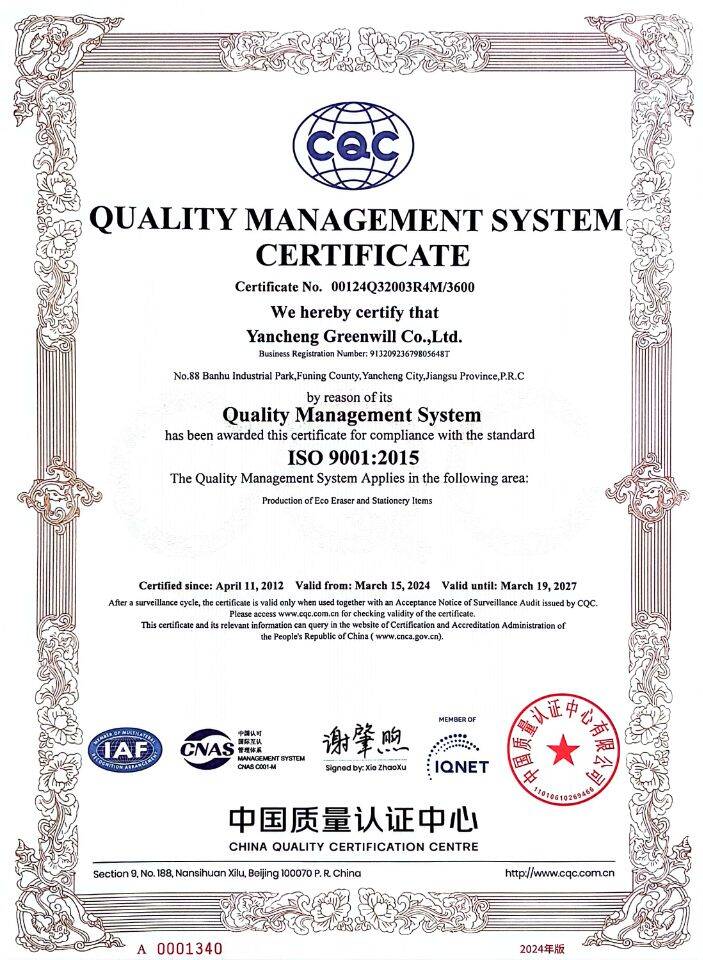
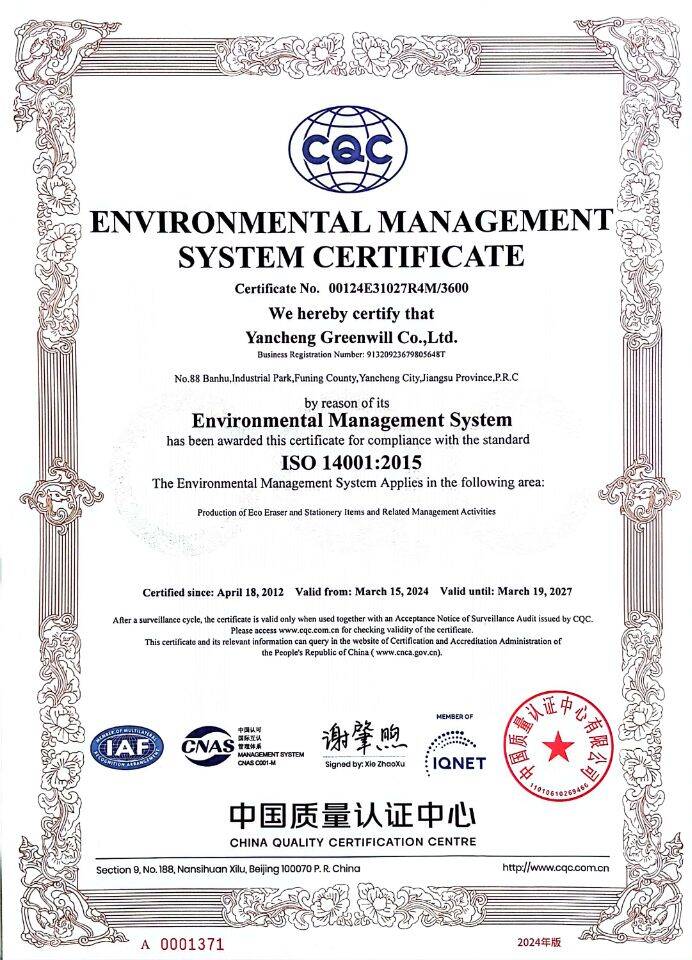
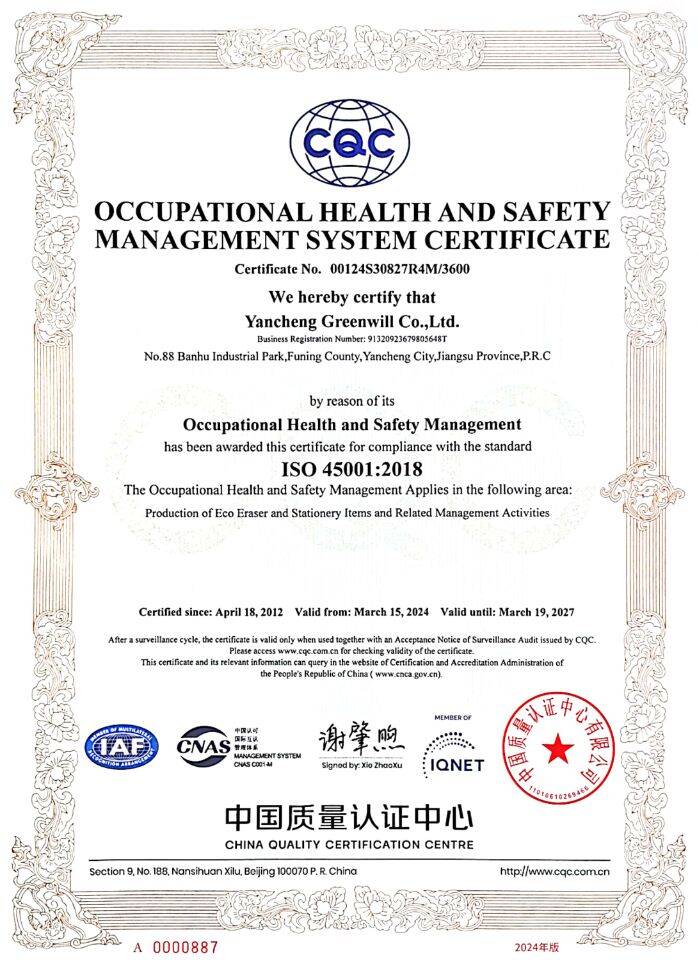
These prove that the factory runs a controlled process. They say nothing about a specific product's chemistry, but they are the first filter in most retailer and distributor audits. Greenwill's system certificates are issued by CQC and share the same validity window, running from 15 March 2024 to 19 March 2027:
- ISO 9001:2015 — certificate No. 00124Q32003R4M/3600, scope: production of eco eraser and stationery items.
- ISO 14001:2015 — certificate No. 00124E31027R4M/3600, scope: production of eco eraser and stationery items and related management activities.
- ISO 45001:2018 — certificate No. 00124S30827K4M/3600, scope: production of eco eraser and stationery items and related management activities.
Note the practical detail buyers often miss: the scope statement defines what the certificate covers. A certificate written for eraser and stationery production does not automatically extend to every new category a supplier launches. If a buyer is sourcing a product outside the stated scope, the certificate is not the evidence they think it is.
Layer 2 — Material and product test reports
This is the layer that answers the question "is this product safe for the people who will use it?" For erasers and sharpeners, the standard set most frequently requested by European and North American buyers includes EN 71-1/2/3/9, REACH, PAHs, SVHC and ASTM D-4236. Greenwill states that its products are controlled from raw material to finished goods against this set of international safety and environmental standards.
The material choice behind the product determines how much testing is required. Greenwill's eraser range uses premium TPR / TPE / eco PVC rubber, with PVC-free formulations available across several lines. TPR-based erasers are typically specified as PVC-free, low-residue and dust-reducing — properties that are documented rather than claimed, which is why buyers should ask for the report rather than the marketing line.
Layer 3 — Sustainability and factory-level schemes
Beyond product safety, a growing number of retail programmes require evidence of environmental and social responsibility at the site level. Greenwill lists FSC, BEPI and ISO certifications in this layer, alongside a stated commitment to green manufacturing, energy conservation and circular design.
Applied at product level
Standards only become useful when they are attached to a specific SKU. The table below shows how the framework is stated at product level across Greenwill's eraser and sharpener lines.
| Product line | Reference models | Material | Standards stated |
|---|---|---|---|
| Quartz sand eraser (ink and pencil) | GW023, GW024 | TPR rubber + quartz sand | EN 71, SVHC, PAHs, PVC-free |
| 2-in-1 eraser sharpener | GW007 / GW006 / GW013 / GW015 / GW009 | TPR eraser, stainless steel blade, PP shell | EU EN 71-1/2/3/9, SVHC, PAHs compliant |
| Erasable gel pen | KP18001 / KP100751 | ABS + AS plastic, heat-sensitive erasable ink | EN 71, ASTM D-4236 |
| Non-sharpen pencil | EP18004, EP18004-1 | TPE + alloy nib + ABS cap | EN 71, SVHC, PAHs |
Two details in that table are worth pausing on. First, the 2-in-1 eraser sharpener is documented against EN 71 Parts 1, 2, 3 and 9 — a broader set than the standalone eraser, because the device has a blade and moving geometry. Second, the applicable pencil diameter for that unit is stated as standard graphite pencils of Φ7–8 mm, and the stated production capacity for the line is 3,000,000 pieces per year. Compliance and fit are usually verified in the same sample review, which is why specification data belongs in the compliance conversation rather than in a separate technical document.
Step-by-Step Breakdown: A Seven-Step Verification Workflow
The following sequence is designed for a buyer evaluating a supplier for the first time. It moves from classification to contract terms, and each step produces a document a buyer can keep.
- Classify each SKU by intended user and destination market. Decide whether the item is an office supply, an art material or a product for children under 14. For EU-bound school items, that classification triggers the Toy Safety Directive 2009/48/EC and EN 71 Part 1–3 obligations described in the European Commission's Guidance Document No. 15.
- Map the standard set for that classification. Children's stationery points to EN 71; professional art materials point to toxicological labeling such as ASTM D-4236; raw-material screening points to REACH, PAHs and SVHC. Write the list down before contacting suppliers.
- Request documentation in the three layers, not as one bundle. Ask separately for management-system certificates, material and product test reports, and factory-level sustainability schemes. Suppliers that can only produce one layer usually cannot produce the others on request.
- Read the certificate details. Check the certificate number, the issuing body, the stated scope and the validity dates. Greenwill's three system certificates, for example, were issued by CQC on 15 March 2024 and expire on 19 March 2027 — a buyer in 2027 will need to confirm renewal before shipping, not after.
- Cross-check reports against the actual bill of materials. A test report for a TPR eraser does not cover a quartz sand formulation, and a report issued for one colour or design variant may not automatically extend to another. Confirm that the report matches the material and variant you are ordering.
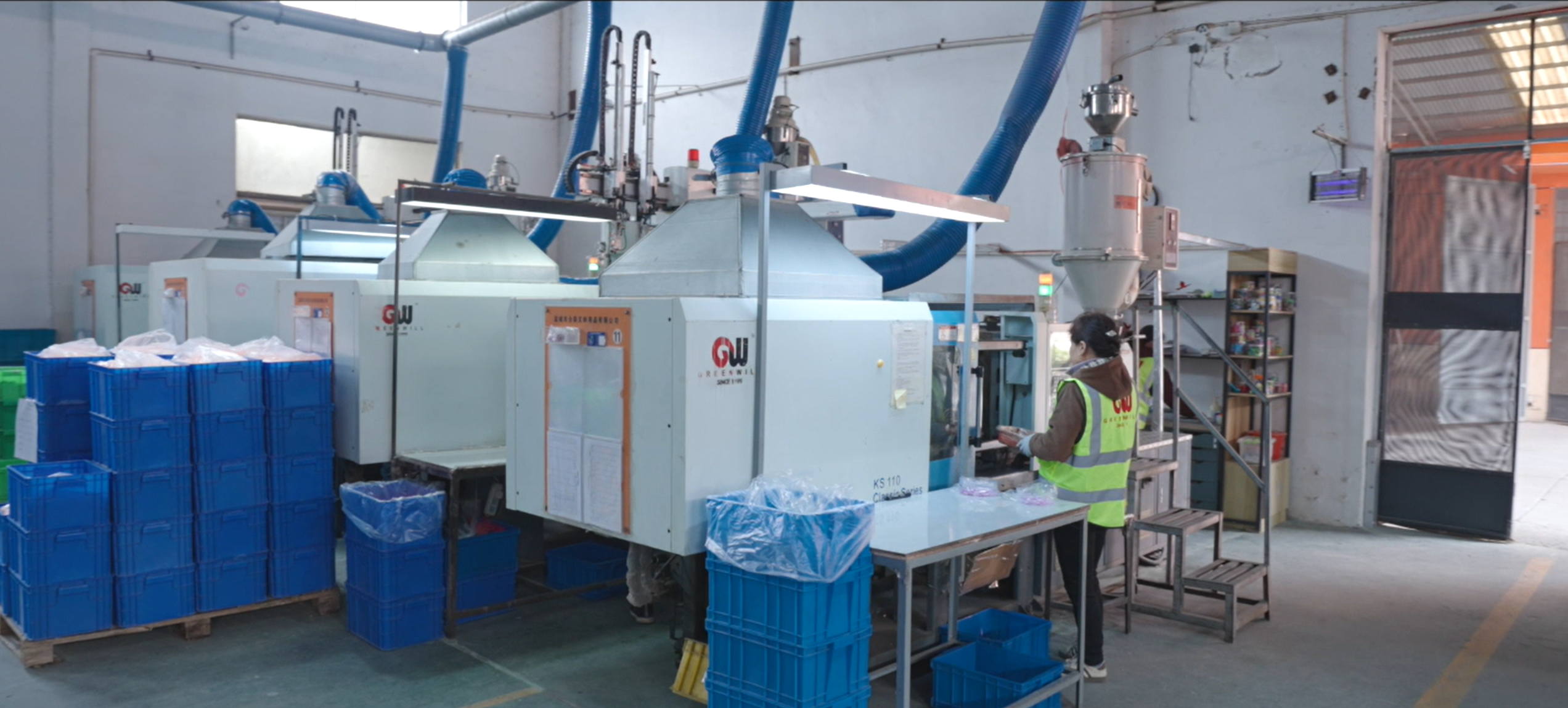
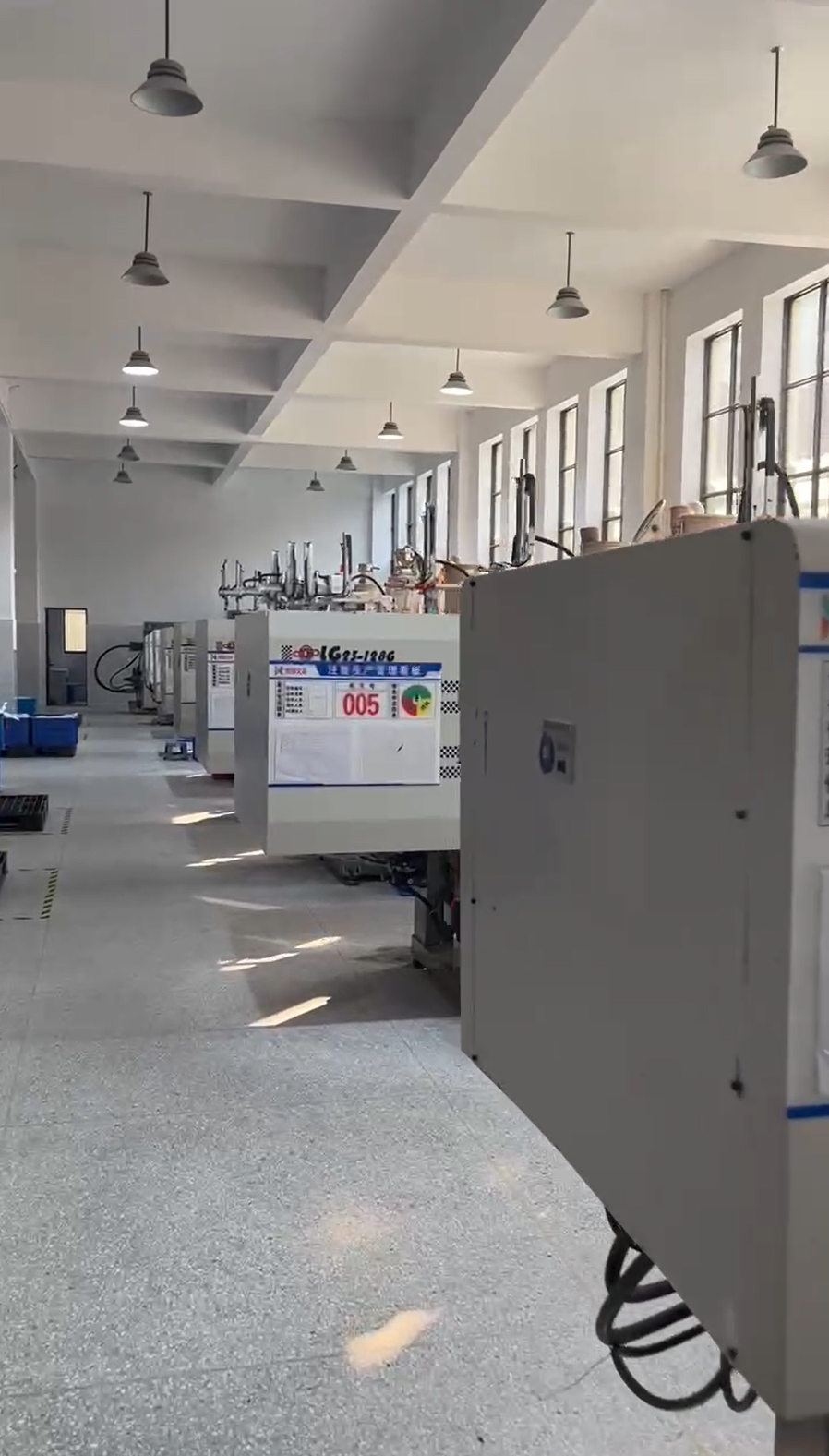
- Validate the supplier's ability to keep documentation current. New materials, new colours and new packaging all reset parts of the file. Greenwill, for reference, operates a 25,000 m² factory with a 10-person R&D team, annual output exceeding 260 tons of erasers and more than 3 million pencil sharpeners, and a stated full-process quality control system running from raw material to finished goods — the kind of structure that allows re-testing to be scheduled rather than improvised.
- Write documentation obligations into the purchase agreement. Specify who owns the test reports, what triggers a re-test, how material changes are notified, and which labelling artwork is approved for each market. This step converts compliance from a pre-order conversation into an enforceable term.
Use Cases: Where Compliance Verification Changes the Decision
Compliance readiness is not an abstract quality. It changes outcomes differently depending on which channel a buyer serves.
Classroom and back-to-school programmes
School-channel buyers typically order eraser sharpeners, pencil toppers and small accessories in mixed assortments, and the intended users are children. This is the highest-scrutiny scenario in the category. The EU toy framework applies to stationery intended for children under 14, and multifunctional designs need component-level documentation because a blade and a plastic shell are assessed alongside the eraser material. Buyers in this channel should expect to provide test reports to their own retail customers, not simply to hold them internally.
Supermarket and private-label retail
For supermarkets and stationery chains, compliance documentation functions as a listing precondition. Greenwill's client base includes gift and promotional product companies, stationery importers and distributors, OEM/ODM partners and supermarkets across markets including Germany, Argentina, Brazil, France, Italy and the United States, with relationships running more than five years and in some cases over ten. In these programmes, eco-friendly materials, consistent erasing performance with minimal residue, and stable quality across high-volume production are the attributes buyers cite when a compliant supplier is retained year after year.
Art and creative channel
Art erasers and creative tools move through a different door. The buyer here is often a specialist retailer or an art-supply distributor, and the relevant documentation leans toward material safety and toxicological labelling rather than toy directives. Documentation requirements such as ASTM D-4236 and REACH are framed around how the material behaves in professional use. A supplier that only understands the school channel will often have the wrong paperwork for this one.
Gift and promotional programmes
Promotional orders are usually deadline-driven and short-run by stationery standards, which puts pressure on documentation timelines. Custom shapes, colours, branding and packaging all change what needs to be verified. Buyers running seasonal campaigns should request the documentation package at the same time as the mock-up, not after artwork approval.
Comparison Table: Which Document Answers Which Question
The most common evaluation error is treating every document as equivalent proof. They answer different questions, and each has a boundary.
| Document type | What it answers | What it does not answer | Typical trigger to re-verify |
|---|---|---|---|
| ISO 9001:2015 certificate | Does the factory operate a controlled quality system, and within what scope? | Is a specific eraser or sharpener formulation safe for its intended user? | Scope change, new product category, certificate expiry |
| ISO 14001:2015 / ISO 45001:2018 certificates | Are environmental and occupational health management systems in place at the site? | Product-level material composition or performance | Certificate expiry, relocation or expansion of production |
| EN 71-1/2/3/9 test reports | Does the item meet EU safety expectations for products used by children? | Raw-material regulatory status across all markets | Material, colour, blade or component change |
| REACH, PAHs, SVHC screening | Are restricted substances controlled at material level? | Mechanical safety or labelling requirements | Supplier material change, updated restricted-substance lists |
| ASTM D-4236 documentation | Is the material appropriately labelled for art and creative use? | Whether the item is classified as a children's product | New formulation, new distribution market |
| FSC / BEPI schemes | Are sustainability and factory-responsibility commitments externally recognised? | Chemical safety of the finished article | Programme renewal, buyer ESG requirement changes |
Read together, the table produces a simple rule: management-system certificates qualify the supplier, while test reports qualify the product. A buyer who collects only the first is auditing a factory. A buyer who collects both is qualifying a purchase.
Frequently Asked Questions
Which certifications and standards should I verify before importing erasers and sharpeners?
Verification depends on the destination market and the intended user, and it should cover three levels. At company level, ask for ISO 9001:2015, ISO 14001:2015 and ISO 45001:2018 certificates — Greenwill's are issued by CQC under certificate numbers 00124Q32003R4M/3600, 00124E31027R4M/3600 and 00124S30827K4M/3600, all valid to 19 March 2027, covering the production of eco eraser and stationery items. At product level, ask for EN 71-1/2/3/9 test reports, REACH, PAHs and SVHC screening, and ASTM D-4236 documentation where art materials are involved. At classification level, confirm whether the item is intended for children under 14, because in the EU that brings stationery such as sharpeners and erasers within the Toy Safety Directive 2009/48/EC and EN 71 Part 1–3. A supplier that can supply all three levels without prompting is materially easier to onboard than one that cannot.
Can a manufacturer support compliance documentation for OEM and ODM projects?
Documentation capability is most visible in custom work, because every change to material, colour, shape or packaging resets part of the compliance file. Greenwill offers both OEM, where a buyer's logo, design and packaging are replicated precisely, and ODM, a one-stop process running from concept to finished product through market trend analysis, conceptual design, 3D modelling, UX optimisation and packaging design. This is supported by a 10-person R&D team, a 25,000 m² factory, and full-process quality control that follows products from raw material to finished goods against standards including EN 71-1/2/3/9, REACH, PAHS, SVHC and ASTM D-4236. For buyers, the operational question to ask is not whether a supplier manufactures custom items, but whether it can re-verify them when the specification changes.
Does compliance verification change the cost or minimum order of an eraser order?
Compliance cost sits less in the unit price than in testing, tooling and variant management. Greenwill's standard MOQ is normally 20,000 pieces per colour and design for erasers and eraser sharpeners, while the erasable gel pen lines KP18001 and KP100751 carry an MOQ of 5,000 pieces. Because testing and tooling scale with the number of distinct variants rather than with total volume, consolidating colourways and designs into fewer, larger runs generally lowers the per-unit compliance overhead. Buyers comparing quotations should therefore compare them at the same variant count and with the same documentation package, since a cheaper quote is often a quote without the reports.
Can I request samples before committing to an order?
Samples are the point where the documentation file and the physical product are checked against each other, and they are worth requesting before an order is placed. Greenwill supports joint development, mould customisation, small-batch trial production and large-scale delivery, which means trial quantities can be produced before full commitment. A practical sample review checks that the eraser material behaves as declared, that the sharpener blade and geometry suit the intended pencil size — Φ7–8 mm for the GW007/GW006/GW013/GW015/GW009 eraser sharpener line — and that the accompanying test documentation matches the sample in front of you. Sample requests can be sent to james@tinlongworld.com or via WhatsApp on +86-15151678868, ideally together with the destination market and intended user group so the correct documentation set is prepared at the same time.
How long does compliant production and delivery take?
Greenwill's stated lead time is 30–45 days. The practical planning point is sequencing: documentation should be requested at the quotation stage rather than after the order is confirmed, because re-testing a changed material or colour can extend a schedule that was built on an earlier specification. Buyers who need a firm date should confirm three things before committing — that the certificate scope covers the product being ordered, that the test reports match the final material and variant, and that any certificate approaching its expiry date will be renewed in time. Quotations, catalogues and current documentation packages can be requested through the same contact channel used for samples.
Conclusion: Compliance Is a Shortlisting Criterion, Not a Paperwork Afterthought
The global eraser and sharpener category is large, price-sensitive and increasingly rules-driven. Estimates for the eraser market alone diverge by more than a billion dollars between research houses, and China's role as the dominant export source is well documented — around USD 137 million of vulcanized rubber erasers exported in 2024, with the United States the largest single destination. In that environment, the difference between two suppliers rarely comes down to erasing performance alone. It comes down to whether the paperwork behind the product survives contact with a retailer's compliance team.
For buyers in the evaluation stage, the discipline is straightforward. Confirm how each SKU is classified in each destination market. Request documentation in three layers: management systems, material and product test reports, and factory-level schemes. Read the certificate numbers, scopes and expiry dates rather than filing them unopened. Then write re-test triggers and change notification into the agreement so the file stays valid after the first shipment.
Greenwill has been producing erasers, sharpeners and writing instruments since its factory was established in 1999, exports around 90% of its output to North America, South America, Europe, Southeast Asia, Oceania and the Middle East, and works with 100 internationally renowned brands, including partners such as Papermate, STAEDTLER and Tesco. Its documentation set — CQC-issued ISO 9001, ISO 14001 and ISO 45001 certificates valid to March 2027, product testing against EN 71-1/2/3/9, REACH, PAHS, SVHC and ASTM D-4236, and FSC, BEPI and ISO schemes — is the kind of evidence a buyer can verify rather than simply trust.
Next Step: Request a Sample and Compliance Package
If you are evaluating eraser, eraser sharpener or pencil accessory suppliers and need the documentation package before shortlisting, start with a sample request. Greenwill can prepare specification-matched samples alongside the applicable certificate and test documentation for your destination market.
Email: james@tinlongworld.com | WhatsApp: +86-15151678868
Website: www.greenwillplus.com | Blog: blog.greenwillplus.com
Kunshan Crystal Culture Co., Ltd (Greenwill stationery) — No.551, Jujin Road, Zhangpu Town, Kunshan City, Jiangsu Province, China.
Have Questions or Need More Details?
Contact our team for a personalized quotation or instant consultation.
Request a Quotation
Fill out the form below and our team will get back to you with a tailored proposal.
WhatsApp Direct Chat
Prefer to chat in real-time? Message us on WhatsApp for instant assistance & quick answers.
- Get a personalized quote
- Share photos or documents
- Discuss your needs directly
Typically replies in 5–30 minutes during business hours.