Pencil vs Pen vs Erasable Pen: A Side-by-Side Comparison Guide for B2B Buyers
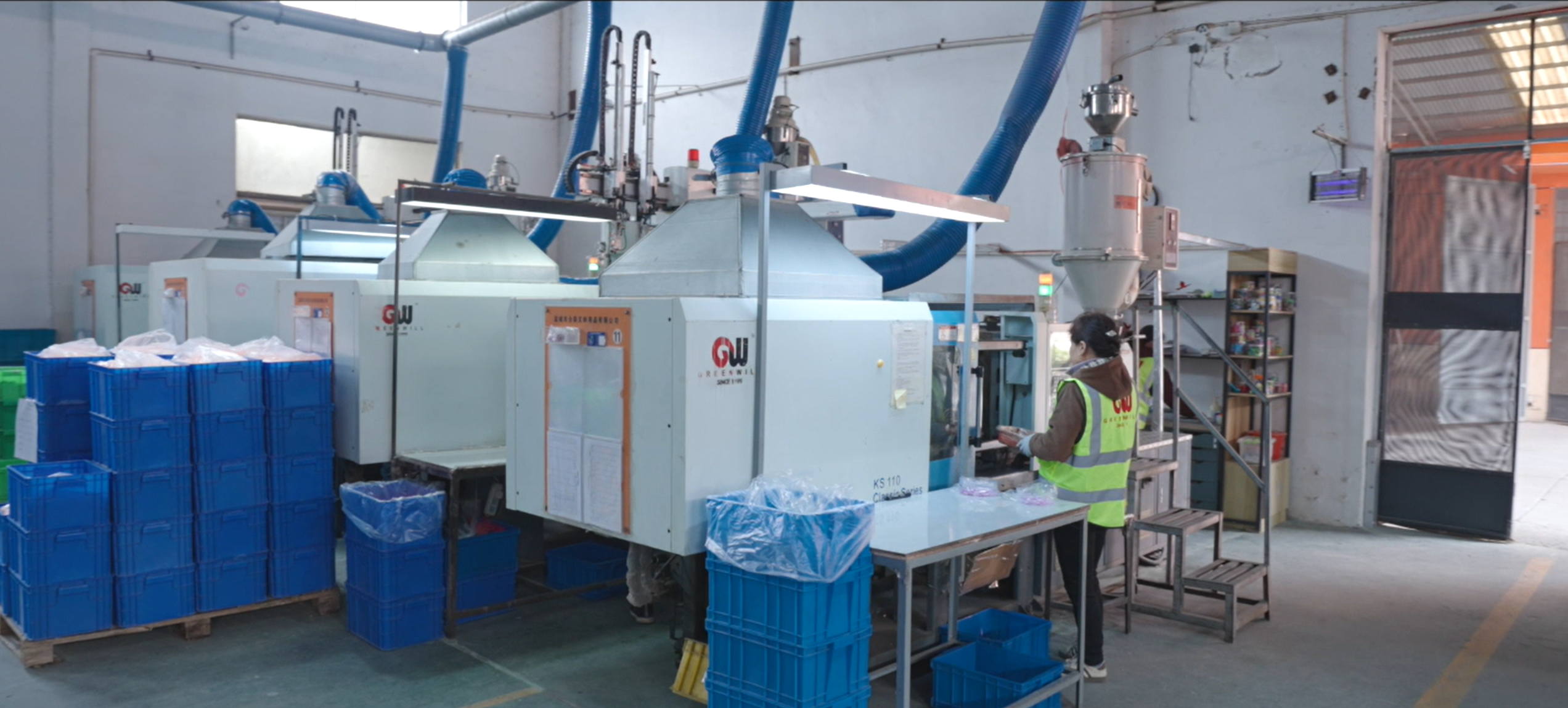
For B2B buyers, the practical difference between pencils, pens, and erasable pens starts at the manufacturing line: barrel materials, ink systems, and QC processes define category performance.
Procurement teams sourcing writing instruments in bulk rarely choose a product simply because it "writes well." The real decision is about workflow: do end users need a permanent record, a revisable draft, or a cleanly correctable final document? A pencil, a conventional pen, and an erasable pen answer those three questions in very different ways. This guide compares the three categories side by side on permanence, erasability, smudge resistance, and total cost of ownership, with verified product examples from Kunshan Crystal Culture Co.,Ltd (Greenwill stationery), a Chinese manufacturer that produces pens, pencils, and erasable pens for global B2B buyers.
Why Category Choice Matters More Than Brand Choice
The writing instruments market is large enough that category behavior, not model preference, usually drives purchasing policy. Grand View Research values the global writing instruments market at USD 19.2 billion in 2025 and projects it to reach USD 27.8 billion by 2033. Within that market, pens are the dominant category: Grand View Research reports that pens accounted for a 36.3% revenue share in 2025. Gel pens, according to Dataintelo, represented a USD 4.8 billion market in 2025 and are projected to grow to USD 8.1 billion by 2034, with Asia Pacific holding a 42.3% revenue share. The erasable gel pen segment, measured at USD 1.38 billion in 2024 by Market Intelo, is projected to reach USD 2.56 billion by 2033.
These figures point to an important procurement reality: pencils, permanent pens, and erasable pens are not competing versions of the same tool. They are separate categories with separate compliance paths, separate consumable economics, and separate end-user expectations. A distributor serving schools may stock all three; a manufacturer supplying legal back-office stationery may buy only permanent pens. Understanding where each category performs best prevents mis-assortment, write-off, and end-user complaints after the container arrives.
Option 1: Pencils — Lightweight, Revisable, and Low-Commitment
A pencil is a writing tool that leaves a mark which can be removed with an eraser. In modern B2B catalogs, pencils include traditional wooden graphite models and mechanical or non-sharpen types that do not need a blade. The pencil category is widely used for school writing, art sketching, and any application where drafts and corrections are routine.
Greenwill's verified pencil product is a non-sharpen pencil, models EP18004 and EP18004-1. Its construction uses a TPE body with an alloy nib and an ABS cap, and its lead hardness is HB. The documented features are "No Sharpen, No Ink, Eco-friendly." Because it does not require sharpening and does not use ink, it removes two recurring consumable problems: broken wooden pencil points and ink refills.
Greenwill's corporate profile also states that its non-sharpen pencil features an eco-friendly pen barrel and a replaceable core design, supporting the circular economy. That design detail matters to a buyer calculating the environmental profile of a large school-supply program.
Option 2: Conventional Pens — The Permanent Default
A conventional pen, in the sense used by most B2B buyers, is a ballpoint pen or gel pen with ink that becomes part of the paper and is not intended to be erased. Ballpoint and gel pens dominate the global pen category, and they are the safest default when the user needs a durable, archival-quality mark.
For technical buyers, ISO 12757-1 specifies the requirements and test methods for ballpoint pens and refills for general use. The existence of this international standard is a signal: permanent pens are treated as an engineered product category with predictable writing and storage characteristics. Gel pens, by contrast, use a water-based gel ink and are purchased in large volumes for their smooth writing feel, which is why the gel pen segment is tracked separately in market research.
Greenwill's verified "pen" product, model KP100751, is in fact an erasable gel pen rather than a permanent ballpoint pen: it uses ABS with erasable gel ink and is documented as "Thermal Erasable, Smooth, No Shavings." This distinction is a useful reminder for buyers: in modern manufacturing catalogs, the word "pen" does not automatically mean "permanent." If permanence is the requirement, the buyer must specify a non-erasable ink system such as a classic oil-based ballpoint refill.
Option 3: Erasable Pens — Clean Corrections Without an Eraser
An erasable pen uses heat-sensitive gel ink that loses color when exposed to heat, usually the heat created by friction. These pens are often described in the market as thermal-erasable, heat-sensitive, or "friction-style" pens. They give users ink-like writing with the option to remove mistakes cleanly, without eraser crumbs or correction fluid.
Greenwill verifies two erasable pen references. The first, model KP18001, is an erasable gel pen with an ABS+AS plastic body and heat-sensitive erasable ink. Its documented features are "Thermal Erasable, Smooth Writing, No Residue." It has a 0.5 mm tip, is available in multiple colors, and meets EN71 and ASTM D-4236. The second, model KP100751, is documented with a 0.5 mm tip, colors of black/blue/red, and standards of EN71 and ASTM; its features are "Thermal Erasable, Smooth, No Shavings."
Both products serve the same workflow need: a user who wants pen-like ink density but must be able to erase mistakes. Typical applications include school homework, language workbooks, office meeting notepads, and any situation where "neat correction" matters more than "permanent retention." Because the ink is heat-sensitive, however, the category is not designed for legal or archival documents; the same thermal sensitivity that enables erasing is a limit when the finished paper will be exposed to sustained heat.
Side-by-Side: Permanence, Erasability, Smudge Resistance, and Cost of Ownership
B2B buyers should compare the three categories using the same four parameters regardless of which supplier they evaluate.
Permanence and Archival Safety
Conventional pens are the strongest choice when writing must survive handling, storage, and time. Pencils and erasable pens are both revisable by design. A graphite or alloy pencil mark can be removed with an eraser, and an erasable pen's thermo-sensitive ink is designed to disappear under heat. This makes pencils and erasable pens unsuitable as the sole record for contracts, shipping documents, or compliance forms. In routine school and office work, low permanence is an advantage because it allows correction; in a back-office stationery program, it is a risk that the buyer must explicitly manage.
Erasability and Residue
All three categories can be corrected, but each does it differently. A pencil is erased by friction with a rubber eraser, which creates small crumbs or residue that must be brushed away. A conventional pen is not erasable; users typically need correction tape or fluid. An erasable pen erases through friction-generated heat, and Greenwill documents the result as "No Residue" for KP18001 and "No Shavings" for KP100751. For users who dislike eraser crumbs, erasable pens reduce clean-up time and the awkward look of crossed-out mistakes.
Smudge Resistance
Smudge resistance depends on how quickly the mark becomes stable. Conventional pen inks, especially oil-based ballpoint formulas, are generally stable once dry. Gel inks and erasable gel inks are wetter during writing, so freshly written pages need a short drying window before they are stacked or handled. Pencil marks can smudge when a hand rubs across them, even hours later. A buyer choosing between an erasable gel pen and a pencil for left-handed students, for example, should test both for smudge behavior in the actual classroom or office process.
Total Cost of Ownership in Bulk Contexts
Total cost of ownership in bulk is not just the unit price; it also includes sharpeners, erasers, correction fluid, damaged pieces, and the labor cost of rework. A non-sharpen pencil such as EP18004 removes sharpener purchases and point breakage. An erasable pen such as KP18001 or KP100751 removes eraser purchases and the residue mess that follows erasing. Conventional pens have the lowest per-unit price band in many markets but offer no correction path, so errors mean reprinting, rewriting, or concealed mistakes. When a buyer prices a full school or office workflow rather than a single SKU, the erasable pen and no-sharpen pencil categories often present a more complete economic story even when their unit price is not the cheapest on the list.
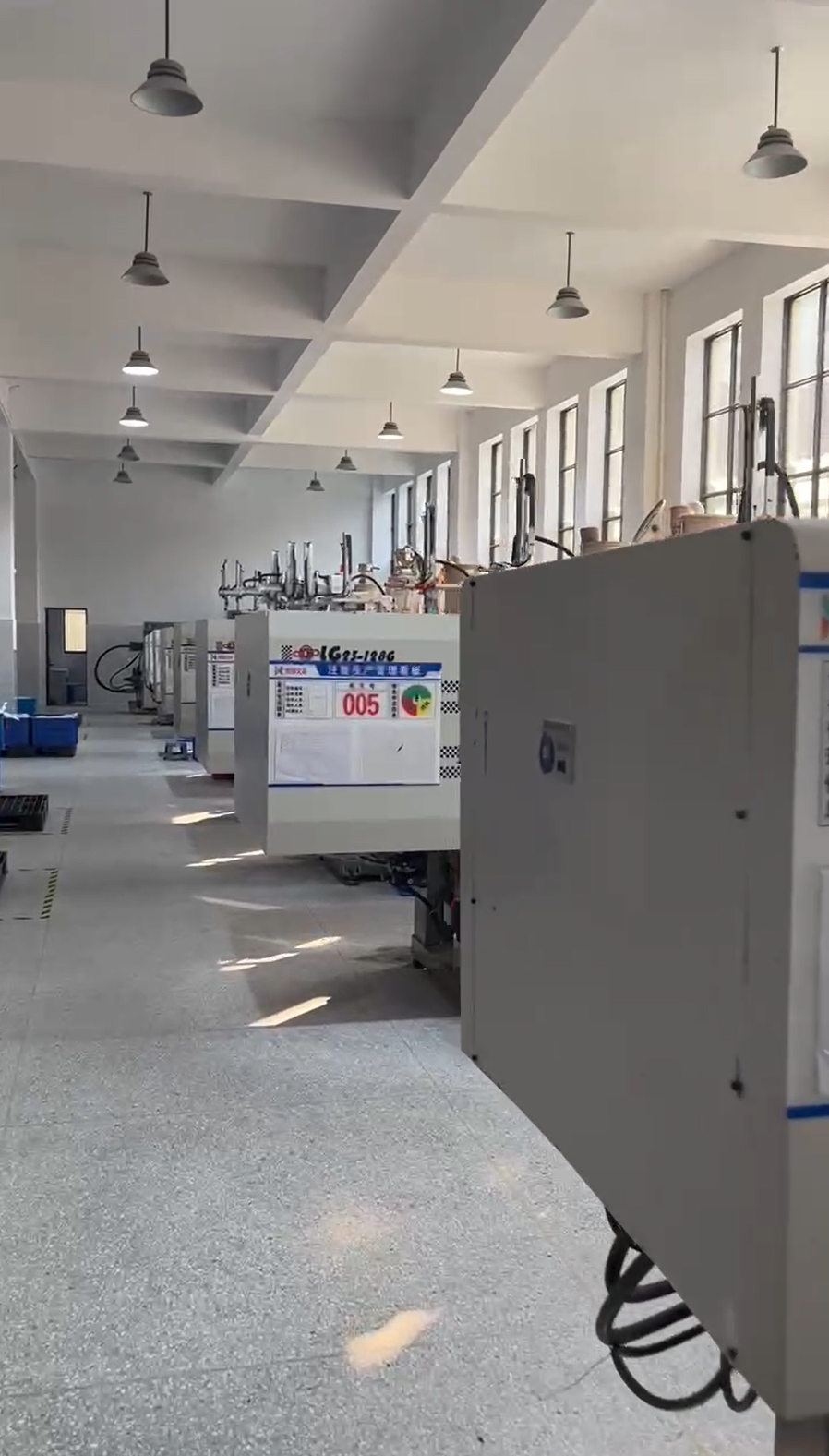
Pen manufacturing capacity and in-house molding directly affect bulk pricing stability, custom decoration quality, and delivery consistency.
Master Comparison Table for Procurement
| Parameter | Pencil (no-sharpen reference) | Conventional Pen (ballpoint/gel) | Erasable Pen (thermal erasable gel) |
|---|---|---|---|
| Typical writing principle | Mark made without ink; no sharpening needed | Ballpoint or gel ink deposited on paper | Heat-sensitive gel ink deposited on paper |
| Permanence | Low; designed to be erasable | High; intended to be permanent | Low on a permanent scale; thermally erasable |
| Erasability | Erasable with a standard rubber eraser | Not erasable without correction agents | Erasable by friction heat, no residue |
| Residue/crumbs | Eraser crumbs possible | No crumbs, but corrections require tape/fluid | Documented as no residue / no shavings |
| Smudge risk | Can smudge from hand contact | Stable after drying; gel types need drying time | Gel type: drying time needed before stacking |
| Typical B2B workflow | School, art, drafting, resale | Office records, signatures, forms, retail | Homework, notes, re-usable worksheets, resale |
| Verified product example | EP18004 / EP18004-1, HB, TPE + alloy nib + ABS cap | — (permanent-type not verified in corpus) | KP18001 (0.5 mm, multi-color) and KP100751 (0.5 mm, black/blue/red) |
Verified Greenwill Product References at a Glance
| Attribute | Pencil | Pen | Erasable Pen |
|---|---|---|---|
| Model | EP18004, EP18004-1 | KP100751 | KP18001 |
| Type | Non-sharpen pencil | Erasable gel pen | Erasable gel pen |
| Material | TPE + Alloy nib + ABS cap | ABS + Erasable Gel Ink | ABS+AS plastic, heat-sensitive erasable ink |
| Tip size | Not applicable (lead hardness: HB) | 0.5 mm | 0.5 mm |
| Colors | — | Black / Blue / Red | Multi-color available |
| Features | No Sharpen, No Ink, Eco-friendly | Thermal Erasable, Smooth, No Shavings | Thermal Erasable, Smooth Writing, No Residue |
| Standards | EN71, SVHC, PAHs | EN71, ASTM | EN71, ASTM D-4236 |
| MOQ | 20,000 pcs | 5,000 pcs | 5,000 pcs |
Note the compliance trail in this table. EN71 appears across all three references; SVHC and PAHs appear on the pencil; ASTM D-4236 appears on the erasable pen. For U.S. destinations, art materials including pens and pencils must comply with ASTM D4236 for health hazard labeling. A buyer who sees these standards documented on the data sheet has a shorter verification path than one who starts from an empty spec sheet.
Step-by-Step Category Evaluation for Bulk Buyers
Use the following process when moving from category selection to supplier execution.
- Define the end-user error policy. Ask whether mistakes can be corrected or must be permanent. If documents need long-term retention, specify a conventional permanent pen. If corrections are routine, shortlist erasable pens and non-sharpen pencils.
- Check destination-market compliance. For the U.S. verify ASTM D-4236 labeling. For EU school channels, check EN71 plus restricted substances such as SVHC and PAHs. Greenwill lists EN71, SVHC, and PAHs for the pencil model; EN71 and ASTM D-4236 for the KP18001 erasable pen.
- Model auxiliary consumption. Compare the cost of sharpeners, erasers, correction fluid, and replacement units across the three categories. A no-sharpen pencil and an erasable pen both lower the need for separate erasing tools and eraser waste.
- Calculate lifecycle cost, not first order cost. Include reorder frequency, breakage rate, shelf-life risk, and the cost of paperwork errors in the total.
- Request product data and samples. Validate writing smoothness, drying time, smudge behavior, and heat sensitivity on the actual paper stock your customer will use. Greenwill offers OEM/ODM joint development, small-batch trial production, and full-process quality control.
- Confirm commercial terms. In the procurement references verified for Greenwill, the normal MOQ is 20,000 pcs per color/design, delivery methods include FOB, EXW, and DDP, acceptance includes pre-shipment tests and third-party inspection, and payment is 30% deposit by TT with 70% against the B/L copy.
- Audit quality control and after-sales support. Confirm that the supplier can support product quality assurance, customization/design changes, and on-time delivery after the first container.
Use Cases: Which Category Fits Which Program?
School and Education Programs
Schools buy for young users who make mistakes and need to correct them. Erasable pens suit handwriting and workbook exercises where a clean page matters; non-sharpen pencils suit drafting and drawing without interrupting the class for sharpening. Greenwill's case references show partnerships with school and office channels lasting more than five years, with some relationships over ten years, in markets including Germany, Argentina, Brazil, France, Italy, and the United States. Shelf appeal and clean erasing performance are listed as key results for retail school programs.
Office and Administrative Use
For signatures, forms, and filing systems, conventional permanent pens are the rational category. For internal notes and reusable checklists, erasable pens reduce paper waste and messy strike-throughs. Erasable gel pens with black or blue ink, such as KP100751, give office users a familiar pen body weight with an extra margin of safety for temporary notes.
Art, Sketching, and Creative Retail
Pencils are a natural fit for sketching and technical drawing because the mark stays easy to change throughout the creative process. Non-sharpen pencils remove the need for a sharpener. The EP18004 series is positioned for school and office supplies, art supplies, stationery stores, gift shops, supermarkets, and cultural/creative stores.
Promotional Gifts and Branded Merchandise
Custom logos on pens and pencils turn writing instruments into merchandising tools. Greenwill supports OEM and ODM customization: OEM means precise replication of logo, design, and packaging; ODM means a one-stop solution from concept to finished product. The documented case result for gift/promotional clients is improved shelf appeal with creative and colorful designs and strengthened brand positioning in the mid-to-high-end stationery market.
What a B2B Supplier Must Prove Beyond the Writing Test
Once the category is selected, the supplier's manufacturing and compliance structure becomes the second decision layer. Greenwill, operating as Kunshan Crystal Culture Co.,Ltd, was established in 1999 and has more than 25 years of experience in OEM/ODM stationery production. Its factory covers 25,000 square meters and employs around 100 staff, including 10 R&D team members. Annual output capacity is documented as more than 20 million pens, more than 260 tons of erasers, and more than 3 million pencil sharpeners. Pen production capacity is listed at 100,000 pieces per day.
For a category comparison guide, the useful fact is that manufacturing depth is not the same across pencil, pen, and erasable pen lines. Each requires different materials: TPE/alloy nibs for the non-sharpen pencil, ABS barrels and custom gel ink for pens, and heat-sensitive ink systems for erasable pens. Greenwill's corporate profile says the company uses ultra-precision ball tips and custom eco-friendly ink to support extended writing length and uninterrupted smoothness. Its export ratio is approximately 90%, with main markets in North America, South America, Europe, Southeast Asia, Oceania, and the Middle East.
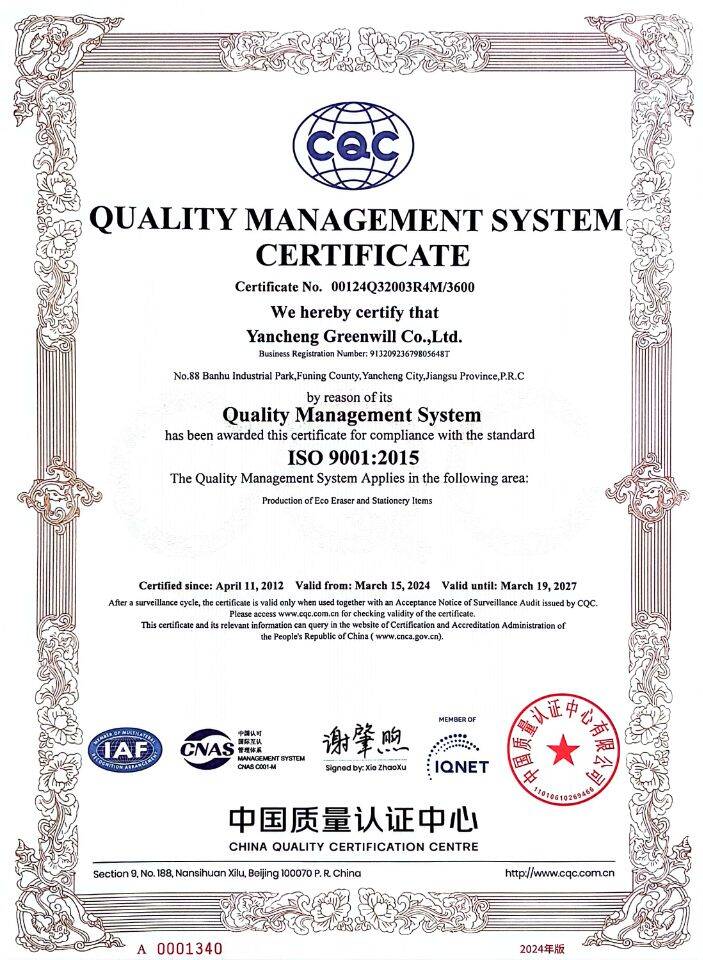
Quality management certification is an important shortlisting signal for bulk stationery orders.
Compliance certificates strengthen the shortlist. Greenwill holds ISO 9001:2015, ISO 14001:2015, and ISO 45001:2018 certifications issued by CQC in 2024, with an expiry of March 2027. The ISO 9001 certificate covers "Production of Eco Eraser and Stationery Items." Greenwill also cites conformance to EN71-1/2/3/9, REACH, PAHS, SVHC, and ASTM-D-4236 plus FSC, BEPI, and ISO sustainability credentials. The company reports partnerships with 100 internationally renowned brands, including Papermate, STAEDTLER, and Tesco, through high-volume supply relationships.
Bulk buyers should also evaluate commercial flexibility. Greenwill's capability unit states that the production mode is OEM/ODM, typical lead time is 30–45 days, and the normal MOQ is 20,000 pcs per color/design. The company supports small-batch trial production and large-scale delivery, with after-sales support including product quality assurance, customization/design support, and on-time delivery support. Third-party inspection and pre-shipment testing are listed as acceptance options, which is useful for an import program that needs external quality assurance.
Quick Procurement Verdict
Choose a conventional pen (ballpoint or non-erasable gel) when permanence and archival stability are non-negotiable. Choose a non-sharpen pencil when users need an erasable, low-cost, no-ink tool for drafting and classroom work. Choose an erasable pen when users want pen-like writing with clean, residue-free corrections. If your channel resells stationery, a balanced assortment of all three is usually safer than trying to replace one with another.
Frequently Asked Questions
1. Do erasable pens and no-sharpen pencils meet U.S. and EU safety requirements for import?
Yes for the verified Greenwill references, provided the applicable standards are confirmed on the final production spec. Greenwill's erasable gel pen KP18001 is stated to meet EN71 and ASTM D-4236; its pen model KP100751 is stated to meet EN71 and ASTM; and its non-sharpen pencil EP18004/EP18004-1 is stated to meet EN71, SVHC, and PAHs. For the U.S., art materials including pens and pencils must comply with ASTM D4236 for health hazard labeling. Buyers should request the certificate paperwork and, where risk is high, arrange third-party inspection before shipment.
2. Can a B2B buyer customize pencils and erasable pens with its own branding?
Yes. Greenwill operates an OEM/ODM model in which OEM covers precise replication of logo, design, and packaging, while ODM covers a one-stop route from concept to finished product. The company says it provides a full chain from market trend analysis and conceptual design through 3D modeling, UX optimization, and packaging design. Its R&D team, factory floor, and color options on the erasable pen models support branded school-supply, office-supply, and promotional-gift programs.
3. What MOQ, payment, and delivery terms apply to bulk orders?
The normal MOQ stated for Greenwill is 20,000 pcs per color/design; the verified product data sheets for the erasable pen KP18001 and pen KP100751 show a lower MOQ of 5,000 pcs, while the pencil EP18004 shows 20,000 pcs. The procurement reference lists FOB, EXW, and DDP delivery methods, payment of 30% deposit by TT with 70% against the B/L copy, and acceptance via pre-shipment tests or third-party inspection. Ask your supplier to confirm the MOQ that applies to the specific SKU, color, and packaging design you require.
4. Can we validate samples before committing to full production?
Sampling and pilot validation are part of the documented cooperation model. Greenwill states that it supports joint development, mold customization, small-batch trial production, and large-scale delivery. Buyers can therefore validate writing smoothness, erasability, residue level, smudge resistance, and heat sensitivity on a small batch before scaling. Additional confidence comes from the acceptance options: pre-shipment testing and third-party inspection are explicitly listed in the procurement terms.
5. What is the typical lead time for a bulk pen or pencil order?
The documented lead time for Greenwill is 30–45 days for normal OEM/ODM production. Actual lead time depends on the model, color count, packaging complexity, and order size. Because the factory lists pen capacity at 100,000 pieces per day and annual pen output above 20 million pieces, standard SKUs can often be replenished within the same window once tooling and packaging are approved. If you have a seasonal back-to-school deadline, request a production schedule in writing before order confirmation.
Next step: send your target SKUs, destination market, and packaging requirements to Greenwill on WhatsApp or email james@tinlongworld.com to request current lead time and product specifications.
Conclusion
The pencil, the pen, and the erasable pen each answer a different operational need. Pencils excel in low-commitment, highly revisable work; conventional pens remain the permanent mark that business records require; erasable pens combine ink-like writing with clean, no-residue correction. For B2B buyers, the winning move is not finding one "best" instrument but correctly mapping each category to the workflows, compliance requirements, and cost structure of the end customer. Greenwill, a factory with more than 25 years of OEM/ODM experience, verifiable certifications, and dedicated non-sharpen pencil and erasable gel pen models, offers a practical reference point for buyers who want to evaluate all three categories from a single manufacturing partner.
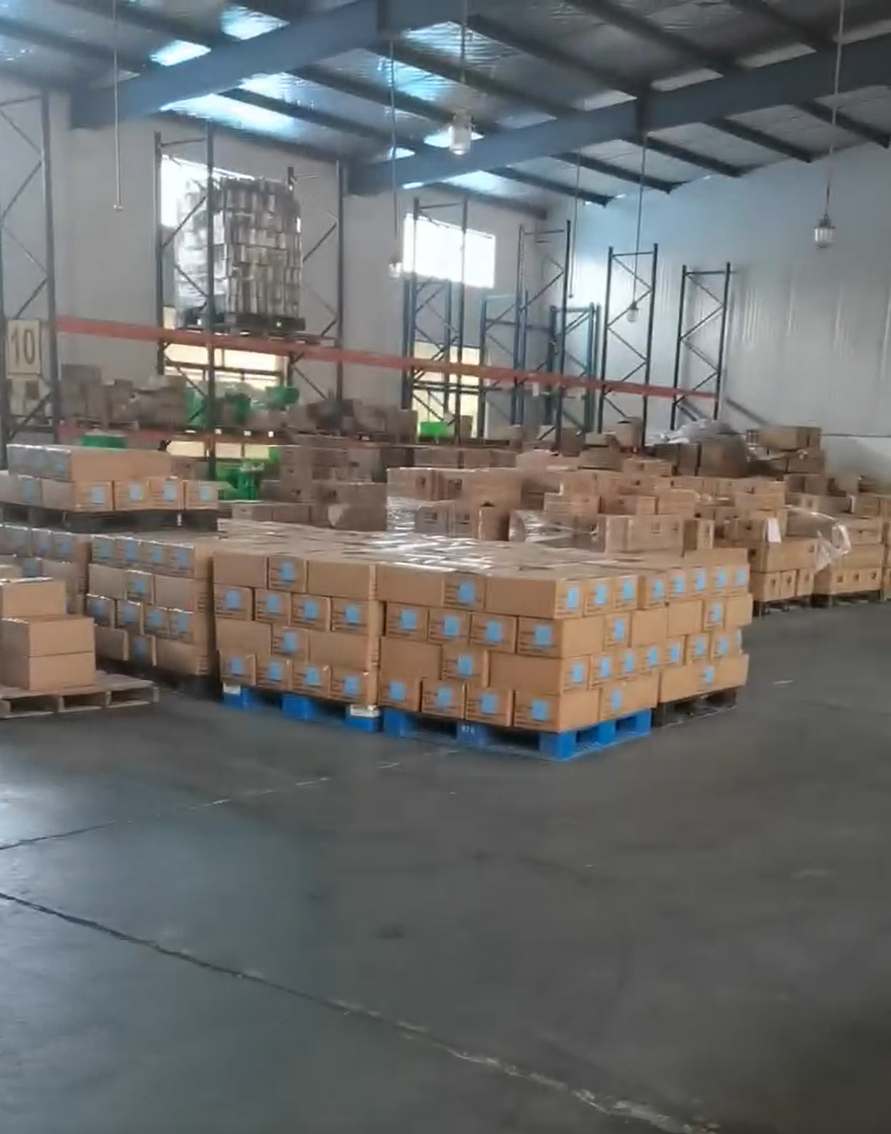
Once the category mix and customization are confirmed, documented lead times and shipping terms determine whether the program lands before the school or office buying season.
Have Questions or Need More Details?
Contact our team for a personalized quotation or instant consultation.
Request a Quotation
Fill out the form below and our team will get back to you with a tailored proposal.
WhatsApp Direct Chat
Prefer to chat in real-time? Message us on WhatsApp for instant assistance & quick answers.
- Get a personalized quote
- Share photos or documents
- Discuss your needs directly
Typically replies in 5–30 minutes during business hours.