How to Build an Eraser Supplier Scorecard: Verifying Capability and Delivery Assurance
A supplier scorecard converts a subjective shortlist — “this factory felt reliable” — into a weighted, evidence-backed comparison you can defend internally. For eraser sourcing, the workable model uses five dimensions: product-range fit, process control, compliance and material verification, order-fulfillment reliability, and commercial fit. Fix the weights before you visit any factory, and require a documented source for every score of four or five.
This guide is written for importers, stationery distributors and brand owners who purchase erasers, eraser sharpeners, pencil toppers and related writing tools, and who need a repeatable way to compare suppliers before committing to a production order. It covers the five scoring dimensions, the weighting logic, the questions to ask during a factory walk-through, and the sample and trial-order steps that close the gap between what a supplier claims and what it delivers.

Photo: Greenwill stationery factory, Kunshan, Jiangsu Province — the type of site a scorecard visit is designed to evaluate.
Why informal supplier evaluation fails in the eraser category
Most eraser sourcing decisions rest on three inputs: a unit price, a sample, and an impression of the factory. All three are weak signals for a category that is bought in large volumes on a seasonal calendar.
- A sample is not a production run. A hand-finished sample can pass an erasing test while the production batch that follows varies in hardness, dust or color.
- The real failure mode is timing and consistency, not a defective first box. A shipment that arrives late to a back-to-school window, or that hardens and cracks during long-term storage, costs the buyer shelf space and reordering — not just the unit price of the goods.
- A low unit price hides the MOQ arithmetic. When a stated MOQ is 20,000 pieces per color and per design, a five-color programme represents 100,000 pieces before any volume discussion begins. If only two colors sell through, the remainder is working capital sitting in a warehouse.
A scorecard does not remove these risks. It forces them into the open before the purchase order, and it creates a written record of what the supplier committed to, which is what makes a later claim — or a later dispute — resolvable.
Industry background: a stable category with shifting growth
Category demand is steady, but the composition of that demand is changing. Third-party estimates place the global eraser market at approximately USD 2.1 billion to USD 2.8 billion in 2025, with projections reaching up to USD 4.3 billion by 2034 (Dataintelo / MarketIntelo). China’s exports of vulcanized rubber erasers totaled around USD 137 million in 2024, with the United States the largest single destination at USD 21.7 million (OEC, Observatory of Economic Complexity).
The sharper signal for supplier evaluation sits in the adjacent sharpener segment: the global pencil sharpener market is projected to grow from USD 1.2 billion in 2025 to USD 1.8 billion by 2030, with multifunctional sharpener-eraser combinations outpacing the category at a CAGR above 8% (2026 Pencil Sharpener & Eraser Market Analysis).
This matters because an eraser sharpener is not one product. It is two production processes inside one SKU: elastomer molding for the eraser body, and metal blade assembly within a plastic shell. A supplier that controls molding but subcontracts blade tooling carries a different risk profile from one that controls both. The scorecard exists to expose that difference before it becomes a delivery problem.
Compliance is the second structural factor. Stationery products intended for children under 14 — including toy sharpeners and erasers — must comply with the EU Toy Safety Directive 2009/48/EC and EN 71 standards, Parts 1–3 (European Commission, Guidance Document No. 15). Professional art materials frequently sit under ASTM D-4236 and REACH requirements as well. For European and North American programmes, compliance evidence is a gate, not a bonus point.
The five-dimension eraser supplier scorecard
The table below is a starting model, not a fixed standard. Adjust the weights to your own risk exposure: a buyer running a seasonal back-to-school programme should weight delivery reliability higher, while a brand owner commissioning custom tooling should weight process control higher.
| Dimension | What it measures | Suggested weight |
|---|---|---|
| 1. Product-range fit | Coverage of the specific eraser and sharpener SKUs in your assortment | 20% |
| 2. Process control | Which production steps are performed in-house, and how they are controlled | 25% |
| 3. Compliance and material verification | Test reports, material identity, and model-level scope of evidence | 20% |
| 4. Order-fulfillment reliability | Capacity math, lead time, scheduling discipline, packing accuracy | 20% |
| 5. Commercial fit and partnership support | OEM/ODM scope, design support, MOQ structure, after-sales terms | 15% |
Score each dimension on a 1–5 scale, where 1 means no evidence available, 2 means claim only, 3 means documented but partial, 4 means documented and verified on site or through a sample, and 5 means documented, verified, and repeatable across previous orders. Any score of 4 or 5 requires a source note: the document name, the observation, or the sample reference. Scores without a source note should be capped at 3.
Dimension 1 — Product-range fit (20%)
Score suppliers against your assortment, not against their catalogue. Build the SKU list first: block eraser, rubber eraser, pencil eraser, white eraser, art eraser, color eraser, ink pen eraser, eraser pencil, eraser sharpener, sharpener with eraser, pencil sharpener with eraser, standalone plastic sharpener, pencil cap, and pencil topper. For each line, record whether the supplier produces it, trades it, or cannot supply it.
A supplier that covers most of your assortment with its own tooling reduces the number of vendors you manage and the number of compliance files you track. A concrete example of range coverage: Greenwill (Kunshan Crystal Culture Co.,Ltd) manufactures quartz sand erasers for ink and pencil (models GW023, GW024), 2-in-1 eraser sharpeners (GW007, GW006, GW013, GW015, GW009), 3D cartoon pencil topper erasers (GW352, GW351, GW180, GW123) and an erasable gel pen (KP18001). The scoring question is not how many products a supplier lists, but how many of your SKU slots these models fill — and which gaps are strategic.
Dimension 2 — Process control (25%)
Process control is the heaviest dimension because it determines whether the second order matches the first. Map the production route on paper: raw material intake, compounding and mixing, extrusion or injection molding, blade insertion, printing, assembly, and packing. Then ask which steps happen inside the factory and which are subcontracted.
Physical indicators help. A supplier running its own molding and printing has more control over color consistency and surface finish than one sending semi-finished parts out for decoration. Greenwill’s production base covers 25,000 m² with injection molding and extrusion molding workshops, in-house eraser printing, and stated annual output of more than 20 million pens, more than 260 tons of erasers and more than 3 million pencil sharpeners, supported by full quality control from raw materials to finished products.
Dimension 3 — Compliance and material verification (20%)
Compliance scoring fails when buyers accept a statement of certification instead of reading the report. Three details matter: the exact model covered, the test laboratory, and the report date. A report issued for one eraser model does not automatically cover a different model, a different color, or a different material compound.
For European distribution, the relevant framework for children’s stationery is EN 71 Parts 1–3 under EU Toy Safety Directive 2009/48/EC. Greenwill states EN71-1/2/3/9, REACH, PAHS and SVHC compliance for its eraser and sharpener lines, with PVC-free construction on the eraser sharpener and quartz sand eraser models, and EN71 and ASTM D-4236 listed for the KP18001 erasable gel pen. At factory level, the company reports FSC, BEPI and ISO certifications. Score the documents, not the adjectives: request the file, check the model number against the quotation, and confirm that the material named in the report matches the material named in the specification.
Dimension 4 — Order-fulfillment reliability (20%)
Delivery assurance is where a scorecard earns its keep, because it is the dimension buyers most often assess by intuition. Convert intuition into arithmetic. Take your required volume, divide it by the supplier’s stated daily or annual capacity for the relevant product line, and compare the result with the quoted lead time.
Greenwill states a normal lead time of 30–45 days, with eraser capacity of 20 tons per day, pen capacity of 100,000 pieces per day, and an annual sharpener capacity of 3,000,000 pieces for the eraser sharpener family. If a programme requires 600,000 eraser sharpeners inside a 45-day window, that requirement represents roughly a fifth of the stated annual capacity — a workload that should be scheduled explicitly rather than assumed. Ask how the supplier sequences peak-season orders, how blade supply is secured, and what happens when a raw material shipment is delayed.
Dimension 5 — Commercial fit and partnership support (15%)
This dimension covers how workable the supplier is over time: whether it offers OEM, ODM or both; whether design work is handled in-house; how MOQ is structured; and what after-sales commitments exist in writing.
Greenwill offers OEM (replicating a buyer’s logo, design and packaging) and ODM (concept-to-finished-product development), supported by a full-process design service covering market trend analysis, conceptual design, 3D modeling, UX optimization and packaging design, together with joint development, mold customization, small-batch trial production and large-scale delivery. Stated after-sales support covers product quality assurance, customization and design support, and on-time delivery support. Longevity is also a scoring input: the company reports working with gift and promotional companies, stationery importers and distributors, OEM/ODM partners and supermarkets for more than five years, some for over ten.
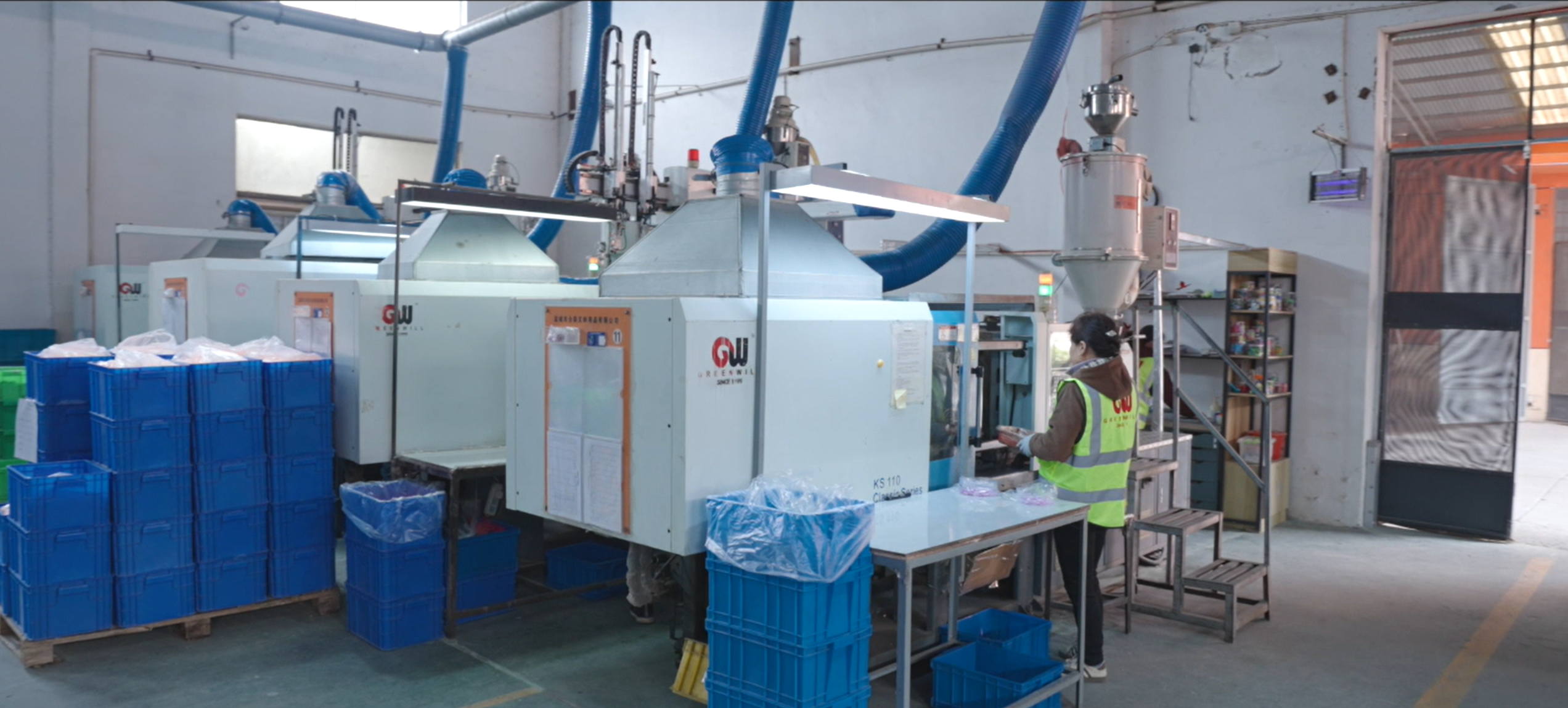
In-house injection molding workshop — a process-control checkpoint during a supplier scorecard visit.
Step-by-step: building and running the scorecard
Step 1 — Fix the assortment and the weights before contact
Write the SKU list and the five weights, and circulate them internally. Weights chosen after a factory visit tend to drift toward whichever supplier made the best impression; weights fixed in advance keep the comparison honest.
Step 2 — Issue a structured evidence request
Ask for the documents you intend to score, not a sales deck: model-level test reports, a capacity statement by product line, a lead-time range, MOQ per color and design, an in-house process list, and a named contact for quality issues. Suppliers able to answer in a single structured response are already demonstrating a form of process discipline.
Step 3 — Plan a factory route, not a meeting
Ask to walk the physical sequence: material store, mixing, molding, blade assembly, printing, assembly, packing, and finished-goods warehouse. Watch how work-in-progress is labelled and how rejected parts are segregated. A route that cannot be shown is itself a data point.
Step 4 — Score on a 1–5 scale with a source note
Score immediately after the visit, while the evidence is fresh. Record one line per dimension explaining the score. If two suppliers finish within a few points of each other, the scorecard has done its job by narrowing the field — the tie-breaker is the next step, not a longer debate.
Step 5 — Run a trial order as the tie-breaker
A small-batch trial production order tests the parts of a supplier’s operation that a visit cannot show: order acknowledgement speed, sample-to-production consistency, packing accuracy, and documentation. Greenwill supports small-batch trial production as part of its OEM/ODM cooperation model, which is the right place to validate a scorecard before scaling.
Step 6 — Recalibrate after the first production run
After the first full order, compare actual lead time, defect handling and communication against the quoted figures, then adjust the scores. The scorecard becomes more accurate with each cycle, and it becomes the baseline for the next supplier review.
Questions worth asking on the walk-through: Which models are produced in-house and which are traded in? How many colors ran on this line last month? What is the MOQ per color and design, and does it change for customized shapes? Which laboratory issued the EN 71 report for this specific model? How are orders scheduled during the back-to-school peak? What is the agreed process when a batch fails an incoming inspection at our warehouse?
Use cases: three buyer profiles, three scorecards
Stationery importer building a back-to-school catalogue. The selling window is fixed and non-negotiable, so raise order-fulfillment reliability to 30% and reduce commercial fit to 10%. Request capacity math per product line and confirm that the 30–45 day lead time applies to the order volume, not to a sample.
Brand owner commissioning custom eraser or topper tooling. Shift weight toward process control and commercial fit. Confirm the depth of the design service in writing — concept design, 3D modeling, packaging design — and clarify who owns the mold and what the MOQ is per customized design.
Promotional and gift distributor running seasonal campaigns. Range fit and MOQ flexibility dominate. A supplier covering erasers, eraser sharpeners, pencil toppers and writing pens under one roof reduces the coordination cost of a mixed promotional pack and leaves fewer compliance files to maintain.
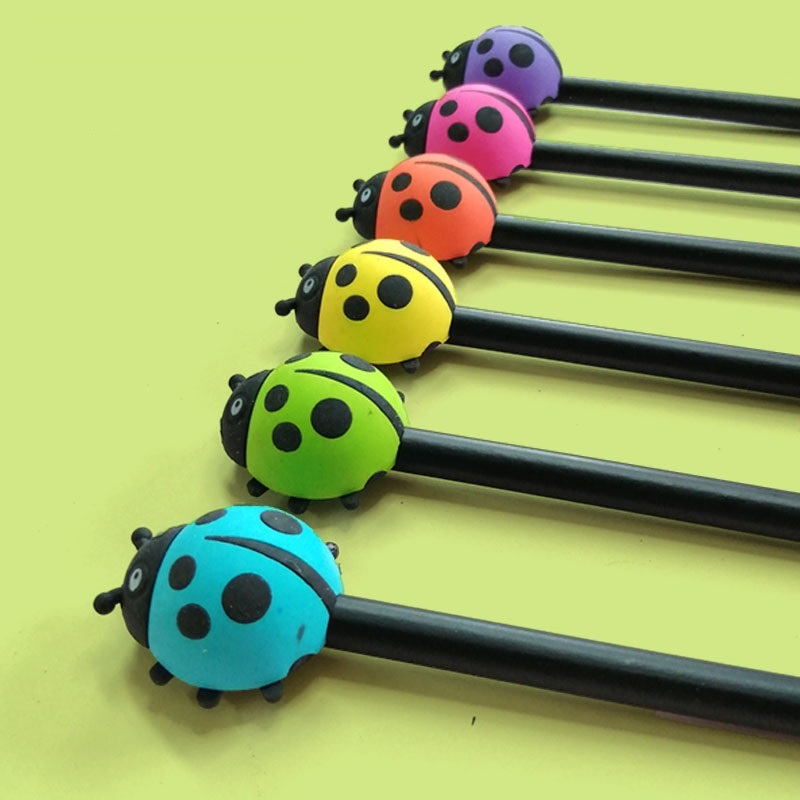
Pencil topper eraser GW352 — an SKU slot that range-fit scoring should record as in-house or traded.
Eraser product-range reference: what range fit looks like in practice
The table below lists published specifications for one supplier’s eraser and sharpener range. It is included as a worked example of how range-fit evidence should be recorded — with model numbers, materials, functions and MOQs — rather than as a ranking of suppliers.
| Product family | Models | Material | Primary function | Stated compliance | MOQ |
|---|---|---|---|---|---|
| Eraser sharpener (2-in-1) | GW007 / GW006 / GW013 / GW015 / GW009 | TPR eraser, stainless steel blade, PP shell | Erasing and sharpening standard graphite pencils (Φ7–8 mm); clean erasing with low crumbs | EU EN71-1/2/3/9, SVHC, PAHs; PVC-free | 20,000 pcs |
| Quartz sand eraser (ink and pencil) | GW023, GW024 | TPR rubber with quartz sand | Erases ink and pencil; also used for rust cleaning; 70 × 16 × 9.4 mm | EN71, SVHC, PAHs; PVC-free | 20,000 pcs |
| Pencil topper eraser | GW352 / GW351 / GW180 / GW123 | Eco-friendly TPR, PVC | Pencil extender and eraser combined in a 3D cartoon design | EN71, SVHC, PAHs | 20,000 pcs |
| Erasable gel pen | KP18001 | ABS+AS plastic, heat-sensitive erasable ink | Thermal erasable writing, 0.5 mm tip, multi-color | EN71, ASTM D-4236 | 5,000 pcs |
Read the table the way a scorecard would. The eraser sharpener family carries the widest compliance list because it combines two materials and a metal component. The pencil topper line is listed with TPR and PVC options, which means material identity has to be confirmed per model rather than per supplier. The erasable pen carries the lowest MOQ of the four families, which changes the arithmetic for a buyer testing a new category before committing to a full programme.
Frequently asked questions
What compliance documents should an eraser supplier provide before an order ships?
For products intended for children under 14, the EU framework is Toy Safety Directive 2009/48/EC with EN 71 Parts 1–3, and many professional art materials also fall under ASTM D-4236 and REACH. Greenwill states EN71-1/2/3/9, REACH, PAHS and SVHC compliance for its eraser and sharpener lines, EN71 and ASTM D-4236 for the KP18001 erasable gel pen, and FSC, BEPI and ISO at factory level. Ask for the report that names your exact model and material, check the issuing laboratory and date, and confirm the report covers the color you are ordering.
How can a buyer verify OEM/ODM capability without a full audit?
Test the chain on a small scope instead of auditing everything at once. Request a 3D model or packaging mock-up, ask which production steps are performed in-house, and confirm whether mold customization and small-batch trial production are offered. Greenwill operates a 25,000 m² factory with a 10-person R&D team, in-house molding and printing, and a full-process design service from market trend analysis through 3D modeling and packaging design, and reports partnerships with around 100 international brands including Papermate, STAEDTLER and Tesco. A workable verification is to commission one customized item and judge the design communication, tooling timeline and first-article quality.
How does MOQ affect the real cost of an eraser programme?
MOQ is normally quoted per color and per design, so a multi-color assortment multiplies quickly. Greenwill’s stated MOQ is 20,000 pieces per color and design for its eraser, eraser sharpener and pencil topper lines, and 5,000 pieces for the KP18001 erasable pen. A five-color eraser programme therefore starts at 100,000 pieces before volume negotiation, while a single-color pen trial starts at 5,000. Score suppliers on how MOQ interacts with your forecast — a low unit price with a rigid color MOQ can cost more in unsold inventory than a higher price with a workable color structure.
How should a sample evaluation be structured?
Treat the sample as a production proxy and test it the way your end user will. Record erasing cleanliness and crumbs, surface finish, color consistency against the approved swatch, and behavior after storage. Greenwill’s eraser products use premium TPR, TPE or eco PVC compounds offering a range of hardness and erasing performance, and the eraser sharpener models are stated to deliver clean erasing with low crumbs and smooth sharpening through a durable blade. Keep the approved sample sealed as the reference for the first production batch, and score sample handling — labelling, correspondence and turnaround — as a signal of order-handling discipline.
What lead time should buyers plan for, and how should it be verified?
Greenwill states a normal lead time of 30–45 days, alongside eraser capacity of 20 tons per day, pen capacity of 100,000 pieces per day, and an annual sharpener capacity of 3,000,000 pieces for the eraser sharpener family. Verify the number by applying it to your own volume: a 600,000-piece sharpener order inside 45 days represents roughly a fifth of that stated annual capacity and should be scheduled explicitly. Then confirm whether the quoted lead time covers production only, or production plus inspection and documentation. Buyers who want to test the figure can request a sample and a current lead-time confirmation through the supplier’s contact channel before placing a full order.
Conclusion: the scorecard is the specification for the relationship
A scorecard does more than rank suppliers. It converts a vague expectation of reliability into a list of verifiable claims — which processes are in-house, which models carry which test reports, what the MOQ arithmetic does to a forecast, and what lead time applies to a given volume. Importers and brand buyers who fix their weights before the first factory visit end up comparing evidence instead of impressions, and they carry a written record into the trial order and the first production run.
Start with five dimensions, five weights and one page of evidence notes. Adjust the weights as your own risk profile becomes clearer, and rebuild the scorecard each season rather than reusing last year’s scores.
Request a sample and a current capability pack
Greenwill (Kunshan Crystal Culture Co.,Ltd) manufactures eco-friendly erasers, multifunctional pencil sharpeners with eraser function, pencil topper erasers and erasable pens as an OEM/ODM supplier, exporting about 90% of production to North America, South America, Europe, Southeast Asia, Oceania and the Middle East.
Website: www.greenwillplus.com | Blog: blog.greenwillplus.com
Email: james@tinlongworld.com | Tel / WhatsApp: +86-15151678868
Address: No.551, Jujin Road, Zhangpu Town, Kunshan City, Jiangsu Province, China
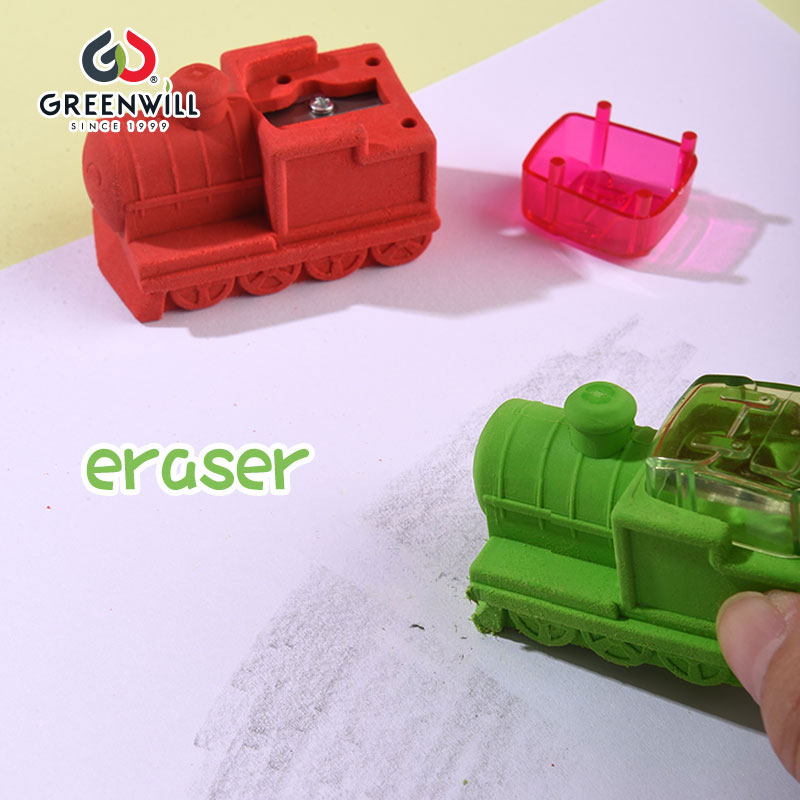
Eraser sharpener family — a suitable starting point for a trial order before full-scale production.
Have Questions or Need More Details?
Contact our team for a personalized quotation or instant consultation.
Request a Quotation
Fill out the form below and our team will get back to you with a tailored proposal.
WhatsApp Direct Chat
Prefer to chat in real-time? Message us on WhatsApp for instant assistance & quick answers.
- Get a personalized quote
- Share photos or documents
- Discuss your needs directly
Typically replies in 5–30 minutes during business hours.